






When Platform meets AI
The Compounding Effect in Agriculture
A companion analysis to the Grab case study
1. Why this case, why now
Grab began in 2012 as MyTeksi — a simple, safety-focused taxi-booking app in Malaysia launched by Harvard Business School classmates Anthony Tan and Tan Hooi Ling. The founding insight was mundane but powerful: Southeast Asian cities were large, fragmented, and underserved by formal transport infrastructure. Within two years the company had rebranded as Grab and was expanding across Singapore, the Philippines, Thailand, and Indonesia.
From the outset, the founders were not building a taxi app. They were building a platform — one that could eventually route any on-demand service through a common driver network and a single consumer interface. This distinction would define every subsequent capital raise, product extension, and strategic decision for the next decade.
In March 2018 the thesis was validated spectacularly: Grab acquired Uber’s entire Southeast Asian operations, with Uber taking a 27.5% stake in Grab in exchange. This single move removed the most dangerous Western rival and crystallised Grab’s regional dominance.
2. Why Agriculture is fertile ground
Three structural features make agriculture particularly amenable to the platform + AI architecture.
First, it is inherently two-sided. Every farmer is both a buyer — of seeds, fertilisers, agro-chemicals, equipment, advice — and a seller, of crop, of dairy, of produce. A platform that serves the farmer well on one side has natural pull to serve him on the other. This is the pivot that makes the network effect real, and it distinguishes agriculture from most other industries where a single participant sits on only one side of the ledger.
Second, it is data-generative in an unusually dense way. Every field is a data point. Every season is a training run. Every weather event, every soil test, every yield outcome creates information that compounds — and the compounding is geography-specific, crop-specific, and season-specific. A platform operating in agriculture generates more usable data per participant per unit time than most digital businesses, because the physical world keeps feeding the model.
Third, it is under-modernised. Vast portions of the agri value chain — from input distribution to crop procurement to price discovery — still operate on informal networks, thin margins, and enormous inefficiencies. The gap between what is possible and what is happening is unusually large. That gap is the compounding surface. It is the room the pattern has to spread before the industry closes around it.
3. What compounds and how
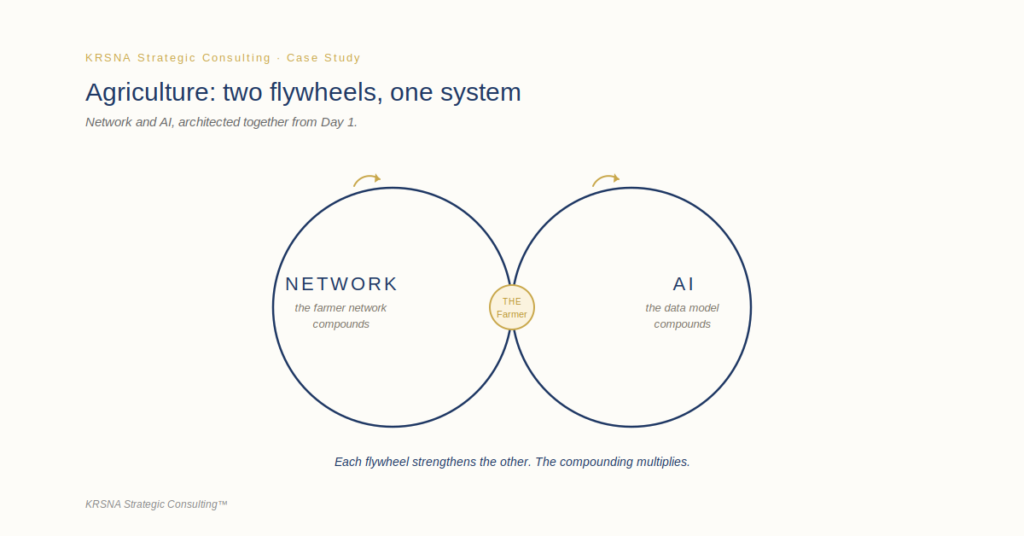
Two flywheels can operate simultaneously in an agri platform of this design.
Flywheel one: the network side. A platform that serves the farmer as an input customer earns his trust as a supplier. As more farmers join, the platform’s input economics improve — volume, coverage, negotiating position with input providers — which improves the offering to every farmer. On the output side, more farmers means more crop supply, which strengthens the platform’s negotiating position with buyers. Buyers find the platform more valuable; more demand comes in; that demand feeds back into better prices for farmers; more farmers join. A classic two-sided compounding loop.
Flywheel two: the AI side. Every season produces data. That data sharpens every subsequent decision. Input recommendations improve as more fields yield outcome data. Yield prediction becomes more accurate as historical patterns accumulate across weather, soil, seed, and practice. Crop-to-buyer matching becomes tighter as demand-side signals become richer. Pest and disease models sharpen the more geography they cover. Even farmer acquisition becomes intelligent — the platform learns which participant profiles compound fastest, and directs its effort there.
The two flywheels do not run in parallel. Each strengthens the other. More farmers on the platform produce more data, which sharpens the platform’s ability to serve each farmer better, which brings more farmers. The network flywheel feeds the AI flywheel; the AI flywheel feeds the network flywheel. That interlock is the compounding effect.
4. The difference: an AI-native starting point
Grab spent a decade architecting network compounding before AI became a design primitive. When AI arrived, it was layered onto an already-mature platform. The compounding was extended, but not fundamentally re-architected.
An AI-first agri platform starts from a different premise. AI is not an overlay. It is embedded in the architecture — in how inputs are matched to fields, in how farmers are onboarded, in how crops are aggregated and routed, in how prices are set. The data loop and the network loop are designed to feed each other from the first transaction.
This has three practical implications.
The compounding surface is larger, because AI is not confined to a post-hoc analytics layer but is present in every decision the platform makes.
The moat is deeper, because it is built into the fabric of the operating model, not into a reporting stack that a competitor can replicate.
The pace of learning is faster, because every transaction is being observed by a system designed to learn from it. Over a horizon of five to ten years, this accelerated learning can produce a widening structural gap between an AI-native operator and a legacy operator that added AI later.
5. Three strategic questions
Three questions adapted from the Grab analysis, worth internalising for anyone building or evaluating a platform + AI business in agriculture.
Is the market large enough that dominance, once achieved, justifies the compounding investment required to reach it? Agriculture is the largest B2B market in most emerging economies. In India alone, it touches a substantial portion of the population directly. The question is not whether the market is large. It is whether the platform can architect its position deep enough to matter at that scale, and whether the operator has the patience to let compounding do its work.
Are there high-margin overlay businesses that can be layered once the core farmer relationship is established? Financial services — credit, insurance, savings. Advisory services — input recommendations, crop planning, market timing. Data services — to buyers, insurers, governments. Each is a high-margin overlay that becomes viable once the core commerce relationship is trusted. The core commerce may be the trojan horse; the overlays may be the prize. Grab’s fintech arm making up the highest-margin layer of the platform is the pattern to notice.
Is the operator choosing patience out of conviction in a structural thesis, or out of inertia? Agri platforms are patient businesses. Farmer trust does not compound in quarters; it compounds in seasons. This is a strength for the operator who understands what he is building, and a liability for the operator who does not. The two look identical from the outside for several years, which is why the discipline question at the heart of the Grab story returns here with equal force.
6. What to watch for
Three leading indicators worth watching as AI-first agri platforms take shape over the coming decade.
Repeat-transaction rate per farmer. The most reliable early signal that the network flywheel is spinning up. Farmers who return, and who bring their neighbours, mean the platform is delivering trusted value — the necessary precondition for compounding.
Data density per participant. The quiet signal that the AI flywheel is compounding. If a platform is generating richer data per farmer per season than its competitors, the model advantages will accumulate faster than the market can see — and by the time the gap is visible from outside, it may already be structural.
Overlay adoption rate. Once basic commerce is established, do farmers begin to adopt financial products, advisory services, and data-driven planning tools? This is the signal that the platform has crossed from vendor to infrastructure. It is also the signal that the high-margin businesses — the ones that ultimately deliver the returns — are becoming reachable.
Closing thought
The compounding effect of platform and AI is not new as a concept. Grab demonstrated one form of it over a decade of patient architecture. What is new is that the architecture is now understood, and that AI has become a design primitive rather than an add-on. The next decade will produce many more forms of the pattern, in many more industries.
Agriculture is one substrate where the pattern will land visibly. It will not be the last. The businesses that succeed will not be the ones with the flashiest AI, nor the ones with the biggest capital. They will be the ones that quietly architect the two compounding forces to reinforce each other from the first day of operation — and that have the patience to let the flywheels spin up over the seasons it takes.
That patience, and that architectural discipline, is what this body of case work will keep tracing across industries as the pattern lands.