





The Silent Veto
The most decisive move in an Indian B2B sale is the one no one announces.
A note on the no that is never spoken — and what to do about it
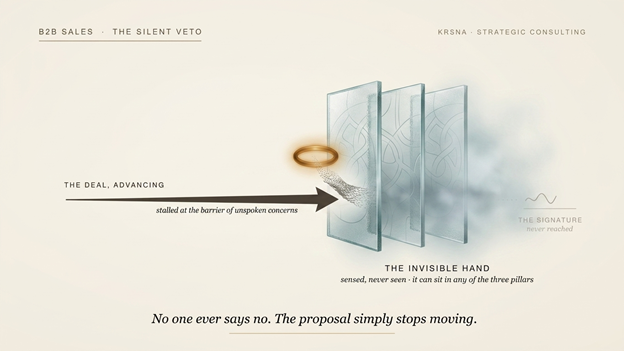
You already know there is no single decision-maker. Anyone who has carried a number for more than a few years has long since buried that fiction — the lone economic buyer, the one throat to choke, the single individual whose yes is the deal. In any purchase that matters, the decision is not taken by a person. It emerges from the alignment of three pillars — the user group, SCM, and the funding pool — each weighing different things, each moving at its own speed.
So let us not spend our time on what you have already worked out. The harder truth — the one that still costs seasoned sellers deals they were certain they had won — is quieter and far less discussed: an account is rarely won by a yes. It is lost by a no you never heard.
This is a note on that no. Where it lives, why it stays silent, and how to see it before it has done its work — and, because naming a problem without offering a way at it is merely tidy diagnosis with no medicine, one of the several ways to draw it into the open.
The signature moves last
Begin with the thing the pipeline review gets wrong. By the time anyone signs, the decision has already been taken. The signature is not the moment of choice; it is the ratification of a choice that formed earlier and elsewhere — in a corridor, a withheld objection, a risk flag quietly raised and quietly settled. The signatory is, more often than not, the last person in the building to move, not the first.
This has a hard consequence for how you read a deal. Most forecasting tracks proximity to signature: how close is the paperwork, has legal seen it, is the purchase order raised. These are trailing indicators. They tell you that the decision has already happened; they do not tell you which way it went, and by the time they move it is far too late to influence. The seller who manages his pipeline by signature-distance is watching the scoreboard instead of the game — and the game, the real one, was decided in rooms he was never in.
The leading indicators are quieter and harder to log: who is championing you when you are not present, who has gone silent, whose concerns have been heard and whose have not. None of this fits neatly into a CRM stage. All of it is the actual state of the deal.
The vote you never hear
If no single person can grant the deal, several can quietly end it. And in Indian B2B, the power to stop is far more widely held — and far more softly used — than the power to start.
This is the asymmetry the imported playbook never accounts for. A yes must be assembled: it needs the user group, SCM, and the funding pool to align, in sequence, over time. A no needs none of that. It needs one person, in one pillar, to decline — quietly, without ever being seen to. One yes requires many; one no requires one. The arithmetic of the room favours the veto.
And the veto stays silent because silence is the rational choice for the person holding it. In a culture of deference and hierarchy, open contradiction carries a cost — to relationships, to standing, to the appearance of being a team player. Withholding carries none. A junior engineer who distrusts your solution will not say so to the promoter. He will simply take a little longer to revert, raise a small reservation to SCM, decline to carry you when it counts. Nothing goes on record. No one has opposed anything. The proposal just stops moving, and no one can quite tell you why.
This is the yes that is actually a no — the warm assent in the room that evaporates the moment everyone leaves it. It is the single most decisive force in the entire sale, precisely because it never declares itself. You cannot answer an objection that was never spoken; you cannot rebut a position no one has taken. And it can sit anywhere among the three pillars: the user-group lieutenant who feels bypassed and stays quiet; the SCM manager who finds you hard to defend and lets the file age on his desk; the finance mind two steps back who senses risk and front-ends a single careful question through procurement.
Reading the tells
The silent veto is invisible, but it is not undetectable. It leaves tells, if you are watching for them rather than for the yes you are hoping to hear. A champion who cools without explanation, whose replies grow shorter. A timeline that slips by a week, and then by another, each slip individually reasonable. A meeting that keeps almost being scheduled. Warmth in the room that never converts into movement between rooms. A question relayed back to you, very precisely worded, that plainly originated with someone you have never met.
None of these is a delay. Each is a vote, being cast in silence. The seller who reads them as logistics — and reschedules, and follows up, and waits — is patiently administering a deal that has already turned against him. The seller who reads them as signal goes looking for the hand.
The promoter is not the exception
It is tempting to believe that in a promoter-led firm the old fiction quietly survives — that here, at least, one man truly decides, and his name is on the gate. It is a costly belief, and it fails in two directions.
First, even the promoter, in a purchase that matters, is usually ratifying a consensus that has formed below and around him. He is not unmoved by his three pillars; he is their summary. The seller who wins the promoter while losing the pillars has won the figurehead and lost the ship.
Second, and more dangerous: the promoter who overrides his three pillars to hand you a yes has given you the most fragile yes in the building. It is a decision his own people did not own and did not shape — and they are the ones who must carry it through execution, through the inevitable friction, through the moment a year later when something goes wrong and someone asks whose idea this was. His signature can start the project. Their silence can still sink it, slowly, in the doing.
One key, for one kind of lock
So what does one do with a no that is never spoken?
There is no single answer, because there is no single situation. The right move depends entirely on which pillar holds the veto and what it is guarding. Let me offer one — not as the answer, but to show the shape of the thing.
Take the most common case: the veto sits in the user group, with someone who feels bypassed. A lieutenant whose judgement was never sought — competent, proud, and quietly wounded — who cannot approve the purchase but can starve it of the support it needs to move. The instinct, the moment you sense him, is to climb over him to the head who can say yes. That is the very move that sets the veto hard, because it confirms precisely the slight he is reacting to.
The counter is the deliberate detour. You route back to the bypassed man — not to sell, but to consult. You ask him the question only he can answer. You let his view visibly shape the proposal. You make certain his fingerprints are on the final recommendation, and that the people around him can see them there. A person consulted does not veto what he helped build. You have not closed him; you have turned a silent blocker into a quiet co-author — and a co-author defends his own work.
That is one key, and it opens precisely one kind of lock. If the veto sits in SCM, consultation is not the move — defence is; you arm them with the basis to justify choosing you, because their silence usually means they cannot yet make your case to the people behind them. If it sits with finance, the move is neither — it is pre-emption; you name the risk and its mitigation yourself, before the concealed question is ever asked, so that by the time it travels back through procurement it has already been answered. Three vetoes, three different keys. And the wrong key in the wrong lock does not merely fail — it jams the mechanism further, because it tells the holder you have misread him.
Which is rather the whole point. Surfacing a silent veto is diagnosis long before it is technique — locating whose no it is, why it is held, and what it is protecting — and diagnosis of that kind does not travel well inside an article. The keys are many. The fit is situational. The reading is bespoke, done in the specific weather of a specific account, not from a column read on a screen. Naming the problem is the easy part, and you have just watched it done. The right key for your particular lock is a conversation, not a paragraph.
The account beneath the logo
The reason the silent veto survives so long, and costs so much, is that it is invisible to urgency. When you need the deal, your attention runs to the person offering the yes — never to the one quietly withholding it. The whole gravity of wanting pulls you toward the wrong end of the room.
Seeing the other end asks for a different posture entirely: the exteriority of the witness, the discipline to watch how an organisation actually decides rather than how you wish it would — to look for where assent is being withheld, not only where it is being offered, and to treat a cooling champion as data rather than disappointment.
There is, in the end, no one to convince. There is a system to read, and a silence to break. Do the reading, find the hand, draw the unspoken into the open where it can be answered — and the signature, the very last thing to move, will move on its own.