






The Disruption You Can See Is Never
the One That Beats You
When a market gets upended, everyone studies the visible move.
The real work was done years earlier, in silence — and it was financial as much as anything else.
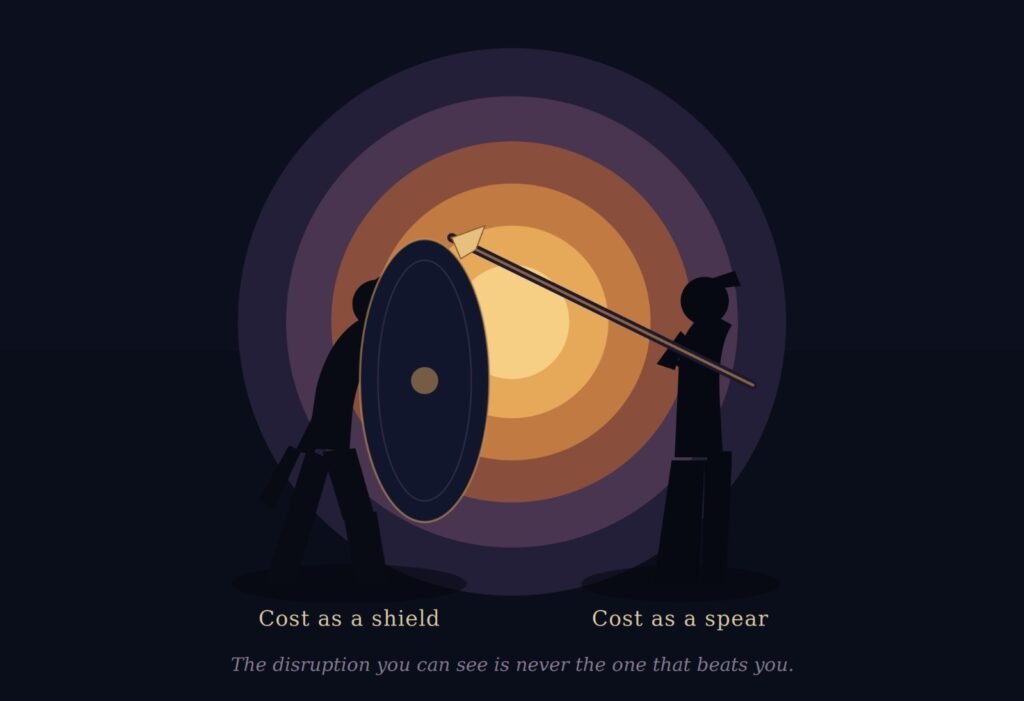
Some years ago, one of a nation’s largest industries was turned inside out by a single late entrant. The story is usually told as a price war — the core product given away, everything adjacent priced at a fraction of the prevailing rate, incumbent margins wiped out almost overnight. One rival was obliterated outright. The others survived only by merging or hunkering down. Even the strongest was left winded.
All of that is true. And all of it misses the point. The price cut was not the disruption. It was the last move in a sequence that had been under construction for the better part of a decade.
The architecture beneath the price
The incumbents fought back the only way they knew: on price, cutting to defend their share. They were always going to lose, for one reason.
You cannot win a price war against someone whose cost floor sits structurally beneath yours.
And that floor was not luck, nor mere frugality. It was engineered — years ahead of the first price cut — as a weapon. This is the distinction most leaders miss. To the incumbents, cost was a defence: something to trim when attacked. To the entrant, cost was an offensive instrument, assembled quietly long before launch and pointed straight at the incumbents’ margins. Consider how it was built.
First, the delivery. Rather than upgrade an ageing estate, the entrant built a wholly new delivery mechanism carrying almost no legacy cost — an approach not previously deployed at national scale in that market. The core product became a near-zero-marginal-cost feature. A rival cannot match your prices when your cost floor sits beneath the level at which theirs can survive.
Second, the resource. The scarce national resource that powered all of this had been secured years earlier — quietly, cheaply, through a small acquisition — and then left deliberately idle. The entrant was buying an option and waiting for the ecosystem and the moment to mature. By the time it launched, the hardest asset in the industry was already paid for at a fraction of what rivals would later have to pay.
Third, the structure. A long-simmering dispute over how much the players owed the state for the right to operate would eventually land a crushing retrospective bill on the sector. The incumbents, whose integrated structures swept every stream of related revenue into the net, were devastated by it. The entrant had legally separated its regulated core from its other activities — so the same liability that maimed the incumbents barely grazed it. That was not luck. It was design, by a late entrant that had watched the incumbents bleed and structured itself never to share their fate.
And when a compulsory industry charge initially worked against the entrant as the smaller party, it did not fight the losing battle head-on. It waited, grew its base until the imbalance closed, and then patiently lobbied the charge out of existence. By the time the incumbents understood the board, the pieces had already moved.
Three dimensions, one encompassing pillar
Step back from the three moves and a pattern appears. One is about the market — where and how to attack. One is about technology — the new delivery mechanism that reset the cost of production. And running through all of them — the resource bought cheap, the low-cost mechanism, the shielded structure — is finance: the encompassing pillar, because every one of those advantages ultimately expresses itself as cost.
That is the deeper lesson. The entrant did not win on any single axis. It won because it thought across all three at once — and because it understood that cost is not a line to be defended but a structure to be weaponised. Cost-finance was not how the entrant survived the price war. It was how the entrant started it.
Why incumbents keep losing to this
The pattern repeats across industries, and it is rarely about capital. The incumbents were not poorer than the entrant. They were narrower. Each defended the one dimension it could see — usually the visible one, price — while being outflanked on the two it wasn’t watching, and mistaking cost for a shield when their rival had already forged it into a spear.
Disruption of this kind is almost never sudden. It looks sudden because we only notice the visible move: the price, the launch, the campaign. The disruption itself was built in silence, years earlier, while the incumbents were still admiring their own scale.
Which means the defensive question most leaders ask is the wrong one. “What is my competitor charging?” tells you almost nothing. The question that matters is harder and quieter: what is being pre-positioned against me right now — across market, technology and finance — that I will not feel for another three years?
The value of an outside witness
Owner-led businesses are especially exposed here, for a very human reason. The person who built the business is often the last one able to see, dispassionately, which of its foundations has turned into a fault line — and where a rival’s cost floor has quietly slipped beneath their own. Pride, proximity and sunk cost all get in the way.
This is precisely where an impartial external advisor earns their keep — Sākṣin, the witness who stands outside the business and reads it across all three dimensions at once: market, technology, and finance. Not to admire your scale, but to name the exposure you cannot see from within it: the price floor a determined entrant could zero out, the legacy asset a shift in method will strand, the dormant liability waiting for the worst possible moment to crystallise.
The visible disruption is never the one that beats you. The floor that beats you is rarely the one you’re defending — it’s the one your rival has been sharpening, silently, into a weapon, while you read this.