






The Death of the Middle
The safest position in business has quietly become the most dangerous.
Demand is splitting in two — and the companies trying to hold the centre are the ones being torn apart.
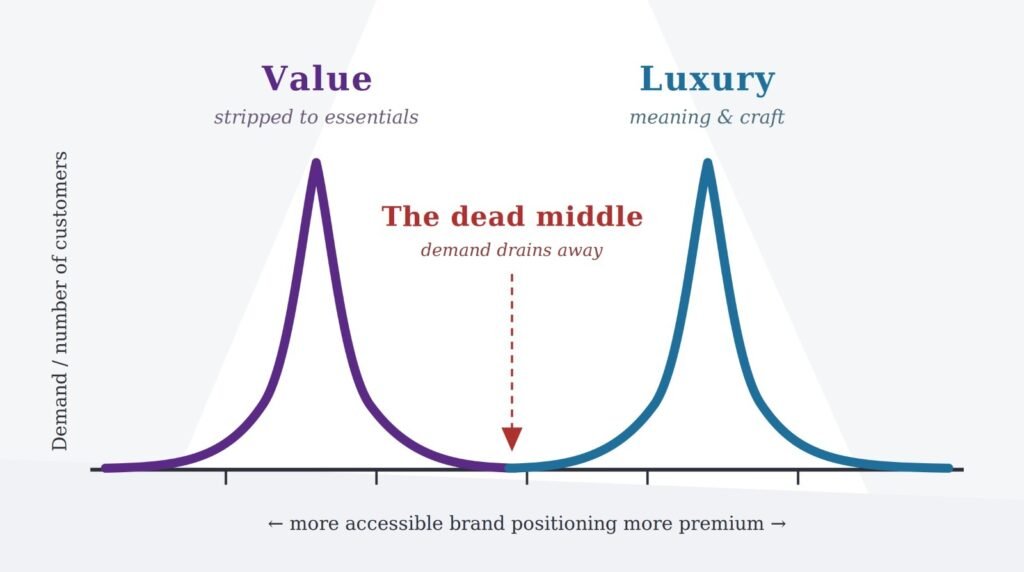
For most of the last century, the middle was the prize. The broad average — decent quality at a fair price, an offer with something for almost everyone — was where the volume lived, and volume was the game. Build for the centre of the market and you built for the largest number of customers. It was received wisdom, and for a long time it was right.
It is now the most dangerous place to stand.
Demand is draining out of the centre and pooling at two poles. At one end, people pay up — for meaning, craft, experience, the things they genuinely care about. At the other, they trade ruthlessly down — for frugal, honest, stripped-to-essentials value on everything they don’t. The distribution that used to be a single tall peak over the middle has split into two, with a deepening trough between them. Economists call it bifurcation. It is easier to just call it the death of the middle.
The same customer, both ends
The instinct is to explain this as two different groups of people — the affluent moving up, the squeezed moving down. That is part of it, but it misses the more unsettling truth. It is frequently the same customer doing both.
The same person will book a once-in-a-lifetime experience and fly to it on the cheapest seat available. Will carry a genuinely premium item and, beside it, the most basic functional version of something they’ve decided not to care about. They feel no contradiction, because there isn’t one. They are simply allocating attention: paying up where it matters to them, and refusing to pay a cent of “middle premium” where it doesn’t.
What they will not do is meet you in the middle — and pay a moderate premium for a moderately better version of everything. That proposition, once the safest in commerce, now persuades almost no one.
The fatal move: splitting the difference
When the centre hollows out, the natural reaction is to defend it. Make the offer a little cheaper to hold the price-sensitive, and a little nicer to hold the aspirational. Split the difference. Hold the line.
This is precisely the move that kills companies in a polarised market. Splitting the difference produces something neither desirable enough to command a premium nor lean enough to win on price. It is legible to no one. The premium buyer finds it unremarkable; the value buyer finds it overpriced. You are not straddling two markets — you are stranded between them, beaten on both sides at once. The middle is not a hedge. It is a trap that feels like caution.
The two honest escapes
There are only two honest ways out, and both require a decisive move rather than a defensive one.
Up is about meaning, not markup. It is not simply charging more; it is earning the right to, by offering craft, experience, identity or emotional resonance that a customer will genuinely pay a premium for. Raising price without raising meaning is just the middle with a higher tag — and the market sees through it instantly.
Down is the move most leaders misread as retreat. It is not. Done with intent, frugal is not a discount — it is a weapon. A deliberately lean, optimally designed offer, built from the essentials up rather than the premium product stripped down, attacks incumbents on their cost base and reaches the vast population the premium players ignore. This is cost as offence, not apology: you are not surrendering margin, you are redesigning the economics so that a low price is a strategic choice rather than a wound. Some of the most disruptive products of the last two decades were built exactly this way — frugal by design, and all the more dangerous for it.
The one unforgivable choice is to stand still in the middle and call it safe.
Why this is so hard to see from the inside
If the diagnosis is this clear, why do so many capable companies drift into the trough anyway? Because it is almost impossible to see from within. Every incremental decision — a small price rise here, a modest feature add there — feels reasonable on its own. Only in aggregate, and only from the outside, does the drift into the dead middle become visible. Pride, sunk cost and the comfort of “this is who we’ve always been” all conspire to keep a business anchored to a centre that is quietly emptying beneath it.
This is the entire value of an impartial outside witness — Sākṣin. Not to admire the business, but to say plainly which way its market is splitting, and whether it is already sliding into no man’s land while everyone inside insists the ground is still firm.
The middle you are defending may no longer be there. The only question that matters is which way you move — and whether you move before the trough decides for you.