





SPECIALTY CHEMICALS MANUFACTURING
The Company That Didn't Know What It Was Good At
The Situation
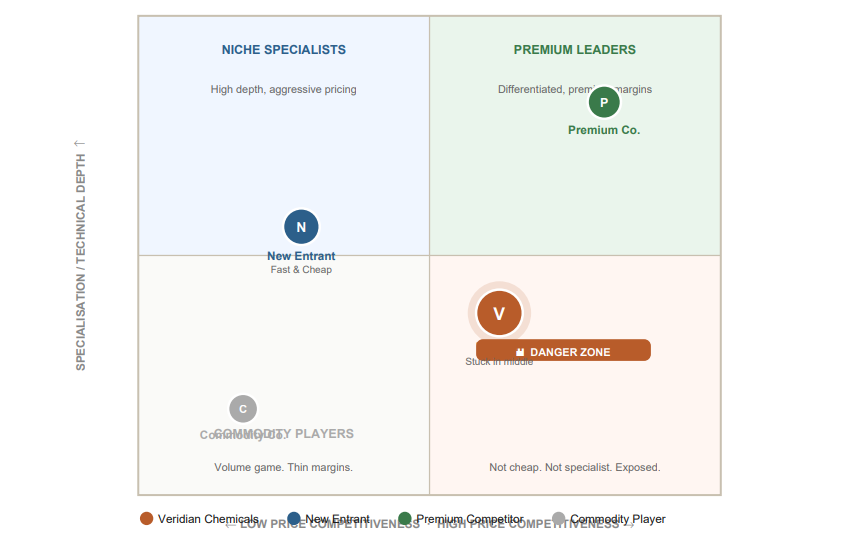
They had been in business for ten years. Around 150 people. A loyal customer base. Decent margins. By most measures, this was a company that worked.
And then a well-funded new entrant arrived — leaner, faster, cheaper on custom formulations — and the cracks became visible almost overnight.
The pipeline thinned. New customer acquisition, already sluggish, stalled completely. The salesforce, when pressed, defaulted to discounting. And when the leadership team sat
down to ask the question that should have had an obvious answer —
“Why should a new customer choose us over them?”
The room went quiet.
That silence was the real problem.
The Challenge
The instinct, as it often is, was to treat this as a sales problem. Train the salesforce. Refresh the pitch deck. Sharpen the messaging.
We pushed back.
A salesforce that cannot differentiate is not a sales problem — it is a strategy problem. The team could not sell a value proposition the organisation had not yet defined. And the reason it had never been defined was not laziness or oversight. It was because nobody had ever forced the commercial team and the technical team to sit in the same room and agree on what the company was — and was not — genuinely capable of delivering.
That gap between commercial ambition and operational truth is where most mid-market companies quietly lose ground. This one was no different.
The Engagement
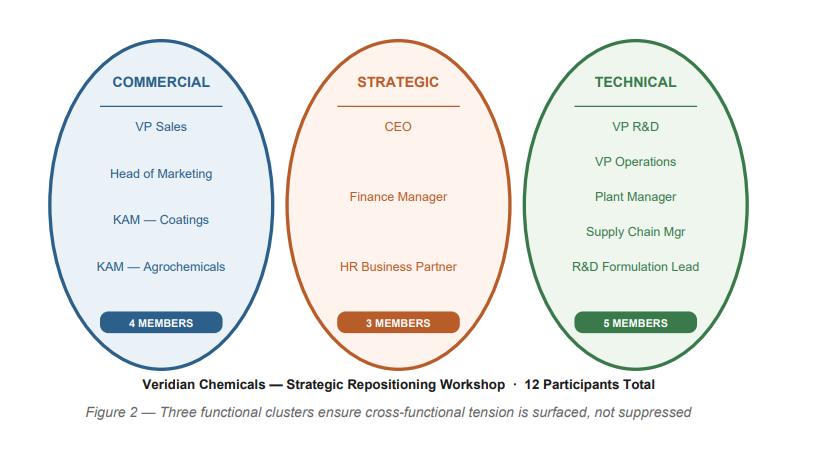
We designed a two-day offsite for twelve members of the leadership team, spanning commercial, technical, and strategic functions. The mix was deliberate. VP Sales alongside the Plant Manager. Key Account Managers in the same breakout group as the R&D Formulation Lead. Finance at the table when operational commitments were being discussed.
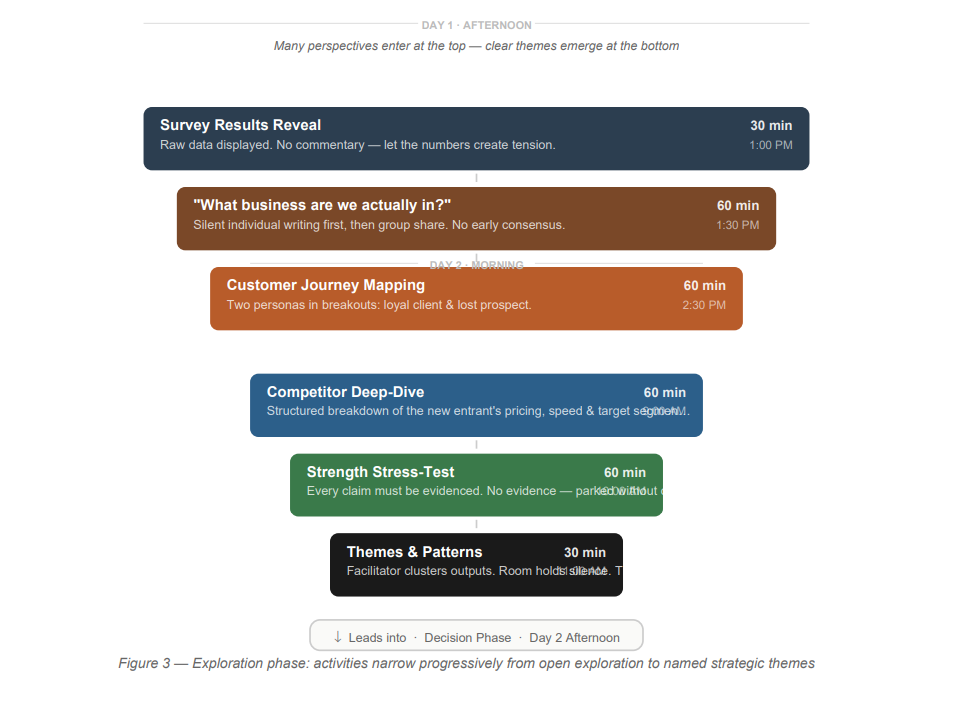
Before the session, we conducted individual pre-interviews with six participants and ran an anonymous survey asking each person to rate the company’s strength across eight dimensions. The results — displayed without commentary on the opening morning — were the best possible start. The divergence in perception between the commercial team and the operations team was significant. It got people talking honestly within the first thirty minutes.
The first day was built around a single discipline: not rushing to solutions. We mapped customer journeys for two very different client profiles — a loyal long-term customer and a prospect lost in the previous year. We conducted a structured analysis of the new entrant’s actual offer — not rumour, not assumption, but what they were genuinely putting in front of buyers. And we ran a Strength Stress-Test: every capability the company claimed as a differentiator had to be evidenced. Undocumented claims were set aside, without debate.
By the end of Day 1, the wall was full. More importantly, so were the conversations over dinner.
Day 2 shifted the energy. The task was now to make choices — the hardest thing for a leadership team that had spent a decade trying to be everything to everyone.
What Emerged
Three things came out of the two days that the organisation did not have going in.
- Defined segments. A shortlist of two customer segments — mid-scale agrochemical formulators and specialist industrial coatings producers — where the company’s combination of batch consistency, technical support depth, and long-standing relationships created a genuinely defensible position. Not aspirational. Evidenced.
- A shared value proposition. A positioning statement that twelve people — from the CEO to the Plant Manager — could articulate in their own words without contradiction. That had never existed before.
- Honest limits. A frank acknowledgement of two areas where the company had been over-promising. Speed of custom formulation turnaround was one. The leadership team agreed, in the room, to stop leading with it until the operational conditions to support it were in place. That kind of honesty is rare. It is also the foundation of a brand that holds.
The Shift
Process outcomes are measurable. Behavioural shifts are harder to quantify — but more durable.
What changed was simpler than a strategy deck. The commercial team stopped walking into client conversations trying to be the answer to everything. They started leading with the two segments and the specific proof points that emerged from the engagement. The technical team, for the first time, had visibility into what was being promised externally — and a seat at the table when those promises were being made.
Three months on, the pipeline in the agrochemicals segment had reopened. Two proposals were in negotiation with mid-scale formulators — the exact profile the team had identified. The discounting reflex had not disappeared, but it had a challenger in the room: a value proposition with evidence behind it.
“I’ve never been in a room where we talked about customers like this before.”
— Plant Manager, Day 2 afternoon
The silence in that first leadership conversation — the one where nobody could answer why a customer should choose them — had become a sentence. Then a paragraph. Then a story the whole organisation could tell.
That is what a well-run repositioning engagement produces.
Interested in a conversation about your organisation’s positioning? Reach out directly.