





Pricing or Positioning
Differentiate or Die
What Two Founders in a Commoditised Market Taught Me in Two Minutes
And why the answer to your problem is almost certainly not social media — or AI.
The Room
I was at an event recently. The kind where people mill around, exchange cards, and have conversations that start with “so, what do you do?” Most of those conversations are forgettable. This one wasn’t.
I found myself standing with two founders — both young, both sharp, both clearly capable. One was a steel trader. The other ran a family-owned NBFC with a range of financial products. Two completely different industries. And yet, within minutes, they were finishing each other’s sentences.
“It’s all about price. Whoever quotes the lowest walks away with the deal.”
The NBFC founder nodded vigorously. He’d just made the decision to invest significantly in digital and social media marketing to acquire new customers. He said it with the confidence of someone who had found the answer.
I was amused. Not dismissively — I understood exactly why it felt like the right move. But I also knew, with some certainty, that it wasn’t.
I had perhaps two minutes before the conversation would splinter. So I said what I could: Jack Trout, differentiation, positioning. They looked at me with the polite blankness of people who’ve heard a word before without ever having had to act on it. Time ran out. I walked away.
But the conversation stayed with me. So here is the fuller version of what I wish I’d had time to say.
The Commodity Trap: How You Got Here
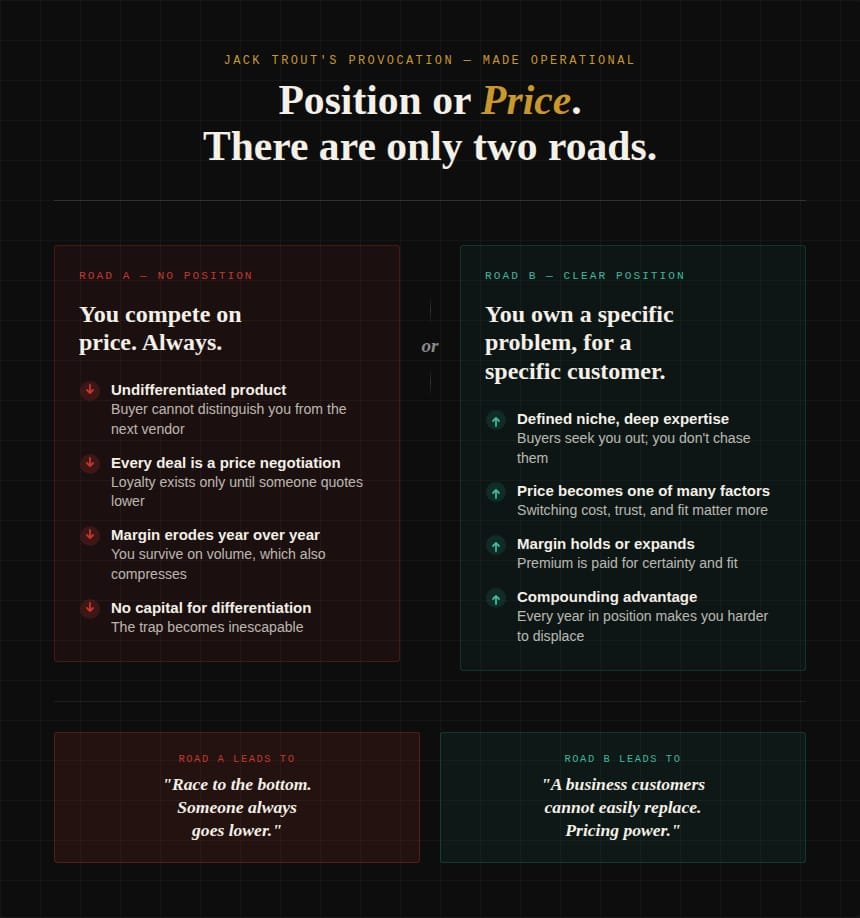
Commoditisation happens when buyers can’t tell the difference between you and your competition — so they default to the only variable they can measure: price. It is not a market problem. It is a positioning problem.
The trap is self-reinforcing. You compete on price, margins compress, you have less capital to invest in differentiation, so you compete harder on price. Round and round. The businesses that escape this loop don’t do so by becoming more efficient at the race to the bottom. They exit the race entirely.
Jack Trout spent a career studying this and put it simply: “Differentiate or Die.” His corollary is equally important — if you genuinely cannot differentiate, then at least compete ruthlessly on price and operational efficiency, because that is your only honest strategy. But most businesses that say “we have no choice but to compete on price” haven’t genuinely tried to differentiate. They’ve tried and found it hard, which is different.
Differentiation is hard precisely because it requires courage. It means choosing a position, which means choosing who you will not serve. Most founders find that deeply uncomfortable. So they stay broad, stay undifferentiated, and wonder why customers only call to ask for a lower price.
The Steel Trader: When the Product Is Identical, Sell the Step After It
Here is the fundamental misunderstanding most steel traders carry: they believe they are in the business of selling steel. They are not. They are in the business of keeping their customers’ production lines running. Steel is a means to that end. And the moment you understand that, the differentiation opportunities become obvious.
Cut-to-Drawing: Absorb a Manufacturing Step
When a manufacturer buys steel, it arrives as coils, sheets, or bars. The first thing their production team does is cut it — to the dimensions required for each component, as specified in engineering drawings. This step costs time, labour, machinery, and floor space.
A differentiating steel trader does this step for them. You take the buyer’s component drawings. You deliver steel blanks that go directly to the machine — pre-cut, pre-dimensioned, ready to use. The buyer’s first operation becomes your last operation.
You are no longer selling steel. You are selling production-ready material. The value proposition is no longer about price per kilogram. It is about total cost — and on that measure, you win.
Production Kitting: Sell the Run, Not the Tonnage
Instead of selling steel by weight, sell it by production run. “Here is everything you need for your Monday morning shift — 47 pieces of this grade, 23 of that, pre-sorted, labelled, and sequenced in the order your production line consumes them.”
Now your customer’s storekeeper doesn’t count. Their production floor doesn’t wait. Their planning team doesn’t chase inventory. You’ve moved from being a supplier to being a production planning partner. The switching cost is enormous — not because you’ve locked them in contractually, but because removing you would require them to rebuild an entire operational capability.
Grade Advisory: Save Them Money While Selling Them Steel
Most small and mid-size manufacturers over-specify steel. They use a costlier grade out of habit or caution. In many applications, a lower grade performs identically.
The trader who walks in and says “you’re using IS 2062 E250 for this component, but E165 is sufficient and 12% cheaper” — that trader has just saved the buyer real money. He has demonstrated knowledge, trust, and genuine alignment with the buyer’s interests. That conversation is worth more than any price discount and is almost impossible to commoditise.
Consignment at Site: Become Structurally Embedded
For your highest-value relationships, consider a consignment model. Your steel, physically sitting in their facility, owned by you, drawn down as consumed, invoiced on consumption. Their working capital is freed. Their inventory anxiety disappears. And you have made yourself structurally embedded in their operation in a way that no price-cutter can dislodge without significant disruption to the buyer.
None of these individually is an impregnable moat. But the compound effect — cut-to-spec material, delivered in production sequence, with grade advisory, on consignment — is a service architecture that takes years to replicate. You are no longer comparable to a price list.
The NBFC: Why Social Media Will Deepen Your Commodity Problem
Let me be direct about the digital marketing decision, because I think it deserves honest scrutiny.
When an NBFC invests in social media and digital channels to acquire borrowers, it is doing what every other NBFC, every fintech lender, and every large bank’s retail arm is also doing — simultaneously, with larger budgets. The cost of digital customer acquisition has risen dramatically as the channel has become crowded. And the quality of that customer is the problem.
A borrower who found you through an Instagram ad was comparison-shopping. They evaluated you against four other lenders in the same session. They chose you because your rate was marginally better or you responded first. None of those reasons create loyalty. The moment a competitor is 25 basis points cheaper, they are gone. You haven’t solved the commodity problem. You’ve automated it and scaled it up.
The Memory No Algorithm Has
A family NBFC has something no fintech can acquire quickly: institutional memory. You have seen borrowers through recessions, demonetisation, a pandemic. You know which businesses in your segment are structurally sound and which are cyclically stressed. You know that the vegetable vendor who looks risky on paper has been repaying reliably for eleven years.
That knowledge is an underwriting edge that no algorithm trained on generic credit bureau data can replicate. The positioning it enables is powerful and authentic: “We have been lending to this community since before credit scores existed. We understand what the numbers don’t say.” That is not a marketing line. It is a structural advantage.
Own a Community, Not a Campaign
Instead of broadcasting to the whole market, embed in a specific community. A trade association. A network of kirana owners in three contiguous districts. A particular manufacturing belt. Become so deeply present in that community that you are simply their NBFC. Not the cheapest. Not the most advertised. The most trusted.
Referral within a tight community is exponentially more valuable than digital acquisition, costs almost nothing, and produces borrowers who stay.
The Graduation Model: Grow With Your Borrower
Most NBFCs treat every loan as a transaction. Here is a differentiated alternative: design a lending career path for your borrower. Start them at a modest loan size. Graduate them systematically as they demonstrate repayment discipline and business growth. Be explicit about it — “our goal is to make you bankable with a scheduled commercial bank in five years. We are the bridge.”
A borrower who understands that you are invested in their journey — not just their EMI — does not shop rates. The relationship becomes aspirational, not transactional.
But Can’t They Just Use AI for This?
I want to address this directly, because it is the right question to ask — and I would rather pre-empt it than ignore it.
Before you close this article and open ChatGPT to build your differentiation strategy — go ahead. I’ll wait.
What you will get back will be accurate, well-structured, professionally formatted, and completely generic. It will tell you to focus on customer experience, build a strong brand, invest in relationships, and consider value-added services. All true. All applicable to every business in every commoditised market on the planet. Which means it applies to your competitor just as much as to you.
AI equalises the generic. If your differentiation strategy is something that can be generated from a prompt, it is not differentiation. It is table stakes dressed up in bullet points.
Here is what AI cannot do.
It cannot replicate the judgment forged by specific experience. I knew in two minutes what those two founders’ problem was — not because I ran a search query, but because I have seen that exact dynamic play out across dozens of businesses over many years. That pattern recognition was built through failure, observation, and iteration across real contexts. It is not promptable.
It cannot replicate trust built over time. The network that put me in that room, the credibility that meant those founders listened to a two-minute provocation from a stranger — that was not generated. It was accumulated. AI produces content. It does not have a reputation.
It cannot replicate a specific point of view. This article is not valuable because it contains information about differentiation strategy. It is valuable, if it is, because it contains a specific observation from a specific room, filtered through a specific way of seeing business problems. No one else was in that room. No one else has this exact synthesis.
And most importantly: AI cannot implement in context. The steel trader does not need a framework. He needs someone who can sit across from him, understand his specific supplier relationships, his cash flow cycle, his customer concentration, and translate “value-added processing” into his next six months of operational decisions. AI can prepare for that conversation. It cannot have it.
The irony is this: as AI makes generic strategy universally accessible, it makes specific, contextual, and relational expertise more valuable, not less. The floor rises. The ceiling rises faster. If you are using AI to do what everyone else is using AI to do, you are back to competing on price — just with better-looking slide decks.
The Honest Conclusion
Differentiation is not a marketing exercise. It is a strategic choice with operational consequences. It requires you to pick a position — which means picking a customer, a problem, and a way of solving it that you will be known for. It means saying no to business that falls outside that position. It means investing in capabilities that serve your chosen customers better than anyone else can.
That is hard. It is uncomfortable. And it takes longer than a Facebook ad campaign to show results.
But the alternative is a business that competes forever on price, where every customer relationship is one cheaper quote away from ending, where margins compress year after year, and where the only exit is consolidation or attrition.
Jack Trout was right. “Differentiate or Die” is not hyperbole. It is a description of where the price-only road leads, eventually, for everyone who stays on it long enough.
The two founders I met that evening are smart, resourceful, and capable of building something meaningful. I hope one of them reads this. And I hope the next conversation lasts longer than two minutes.
If this resonated, or if you’re working through a similar challenge in your business, I’d welcome the conversation.