






Lessons from the Waiting Room
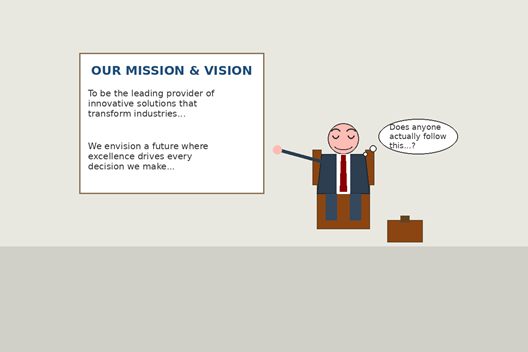
Why Mission and Vision Fail to Drive Growth
Over three decades of walking into corporate offices, I have developed an unusual diagnostic habit. While waiting in reception areas—and salespeople wait often, sometimes because protocol demands it, sometimes because time itself conspires—I read the Mission and Vision statements mounted on walls.
What started as idle curiosity evolved into a forensic practice. These statements, I discovered, reveal far more through what they fail to produce than through what they promise.
Mission vs Vision: More Than Semantic Precision
The confusion between Mission and Vision is not merely definitional—it is symptomatic of a deeper organizational confusion about identity and direction.
The **Mission** articulates present reality: who you are, what you do, why you exist today. It is the organization’s current contract with the world.
The **Vision** articulates future aspiration: who you intend to become, what transformation you seek, where you are headed tomorrow.
Mission grounds. Vision elevates.
Mission is identity. Vision is ambition.
Mission anchors today. Vision pulls toward tomorrow.
When organizations conflate the two, they lose both grounding and direction simultaneously.
The Pattern That Kept Repeating
After reading these carefully crafted statements, I would walk into the organization—into meetings, corridors, cafeterias, production floors. And repeatedly, across industries and geographies, I observed the same troubling pattern:
The stated Mission and Vision bore almost no resemblance to how the organization actually functioned.
This was not about hypocrisy. Most leaders genuinely believed in their statements. The disconnect was more insidious—it lived in the unexamined gap between aspiration and implementation, between what was declared and what was practiced.
I saw it in:
• Decision-making that contradicted stated values
• Customer interactions that violated stated purpose
• Internal conversations that ignored stated direction
• Resource allocation that betrayed stated priorities
• Leadership behavior that undermined stated culture
The statements existed. The behaviors did not align. And everyone had learned to live with the contradiction.
How Dysfunction Spreads: The Network Effect
Here is what decades of observation have taught me: organizational misalignment does not stay contained. It propagates.
One misaligned department infects adjacent functions. One leader operating off-mission creates permission for others to drift. One team ignoring the Vision signals that aspiration is optional.
The spread follows network dynamics—exponential, not linear. Like a virus moving through a population or a crack spreading across glass, misalignment compounds.
Soon, the entire organization operates in a state of functional schizophrenia: saying one thing, doing another, wondering why execution feels so difficult.
This is not a people problem. This is a systems problem.
Why This Becomes the Primary Growth Constraint
I have watched organizations obsess over market strategy, competitive positioning, technological innovation, and capital structure—all while ignoring their most fundamental constraint: internal misalignment.
Growth requires more than ambition. It requires:
• **Clarity** in purpose and direction
• **Alignment** in understanding and action
• **Consistency** in execution and decision-making
• **Coherence** between what is said and what is done
• **Coordination** across functions and levels
When Mission and Vision are decorative rather than operational, none of this exists.
Instead, you get:
• Teams working at cross-purposes
• Decisions that contradict each other
• Execution that fragments under pressure
• Accountability that dissolves into ambiguity
• Energy expended on internal friction rather than external value creation
The organization stays busy. It just does not grow.
Motion without progress. Activity without achievement. Effort without impact.
The Real Work Begins Here
Before strategy sessions and growth plans, before market analysis and competitive positioning, there is a prior question that must be answered honestly:
*Does this organization’s actual behavior reflect its stated Mission and Vision?*
If the answer is no—and in most cases, honest assessment reveals it is no—then every other initiative is building on sand.
This is not inspirational work. It is diagnostic, surgical, uncomfortable work. It requires:
• Honest confrontation with current reality
• Willingness to examine cultural contradictions
• Courage to address misalignment at leadership level
• Discipline to embed Mission and Vision into operational systems
• Persistence to make alignment an ongoing practice, not a one-time event
Most organizations skip this work. They proceed directly to strategy and execution, wondering why nothing sticks.
To Be Continued
The question is not whether your Mission and Vision are eloquently written.
The question is whether they are organizationally lived.
That distinction determines whether you grow—or merely expand.
More to follow on what genuine alignment looks like in practice, and how to build it systematically.