





Is a business a living thing?
A question of stimulus, response, and what an enterprise becomes.
Most owners, asked directly, will say no. A business is a legal entity. A balance sheet. A workforce. A set of contracts. It does not breathe. It cannot feel. It has no consciousness of its own.
And yet, watch how the same owner speaks about it on a difficult day. The business is under strain. The plant is exhausted. The market is punishing us. We need to listen to the customer. The team is hurting. The vocabulary is unmistakably biological. The instinct is older than the answer.
Set aside the metaphysical question — whether an enterprise has consciousness, whether it can reproduce itself, whether it possesses some inner life. Those are interesting questions, but they are not this one. The question worth asking is narrower and more practical.
Does the enterprise receive stimuli, and does it respond?
To this, the answer is plainly yes.
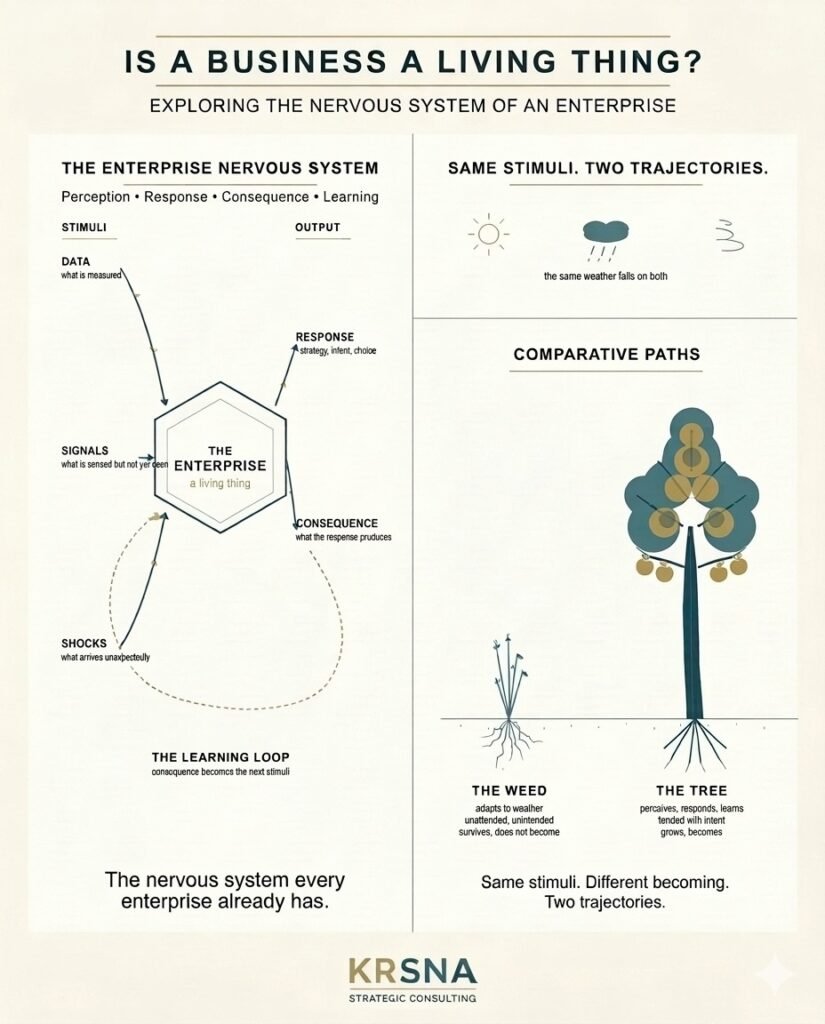
Every enterprise receives stimuli constantly. Some of those stimuli arrive as data — sales numbers, working capital movements, attrition, customer feedback, audit findings, regulatory notices. Some arrive as signals the data has not yet captured — a senior employee’s quiet disengagement, a vendor’s slipping quality, a competitor’s unannounced move, a customer who has stopped complaining because they have stopped caring. Some arrive as shocks the enterprise did not ask for and cannot avoid — a policy change, a currency swing, a key person resigning on a Monday morning.
And every enterprise responds. Sometimes the response is a deliberate decision rooted in evidence. Sometimes it is a gut call made by a founder with thirty years of pattern recognition. Sometimes it is a non-decision — a deferral, an avoidance, a silence — which is itself a response, often the most consequential one. The response, whatever form it takes, produces a consequence. The consequence then becomes the next stimulus.
This loop — perception, response, consequence, and the learning that either takes place or does not — is the closest thing an enterprise has to a nervous system. It is what separates a business that is growing into something from a business that is merely surviving the weather.
And here is where the question becomes interesting.
Most enterprises are partially deaf. They respond crisply to the stimuli they can perceive — the monthly P&L, the quarterly review, the visible complaint — and they are entirely blind to the stimuli they cannot. The complaint that never reached the founder. The risk the auditor did not flag because no one asked. The pattern in the data that no one had the time or the lens to see. The truth that everyone inside the building knows and no one will say aloud.
A deaf nervous system is not the same as no nervous system. The enterprise still responds — it just responds to a fraction of what it is actually receiving. Decisions get made on partial information dressed up as complete information. The consequences arrive on schedule. And because the consequences cannot always be traced back to the stimuli that were missed, the learning loop never closes. The business keeps responding to the same narrow band of inputs and is repeatedly surprised by outcomes that, from the outside, were entirely predictable.
This is the weed. Not because it is failing — weeds are remarkably hardy — but because it is adapting to weather rather than growing toward anything. It survives. It even thrives in seasons that suit it. But it does not become.
The tree is different. The tree is also receiving stimuli, also responding, also bearing consequences. What separates it is that someone is holding the question of what the tree is becoming. Someone is watching the soil, the light, the leaf colour, the pest pressure. Someone is feeding what needs feeding and pruning what needs pruning. Someone is asking, this season, what last season’s stimuli were trying to say. The tree’s nervous system is the same as the weed’s. The difference is custody.
This is the part most enterprise owners under-appreciate. The enterprise will respond to stimuli regardless of whether anyone is tending it. The question is not whether your business is alive — it is, in every sense that matters operationally. The question is whether anyone is taking custody of its perception, and whether anyone is willing to bear the consequence of its responses.
In most enterprises, no one is. The founder is too inside the organism to perceive it; they are part of its nervous system, not an observer of it. The auditor is too far outside; they see the financial trace of decisions long after the stimuli have passed. The consultant is transactional; they arrive with a project, leave with a deck. None of these is the gardener. The enterprise grows or fails to grow on the strength of stimuli no one is consciously curating, and responses no one is consciously evaluating.
The remedy is not more data. Most enterprises already have more data than they metabolise. The remedy is not better decisions, in the abstract; decision-making is the response layer, downstream of the deeper problem. The remedy is to widen the perceptive surface — to ask, deliberately and repeatedly, what is this enterprise actually receiving that we are not seeing? — and to close the learning loop, so that the consequence of yesterday’s response shapes today’s perception rather than disappearing into the noise.
An enterprise that does this is being nurtured. An enterprise that does not is being left to the weather. Both will respond to stimuli. Both will produce consequences. Only one of them is becoming anything.