





Generative AI for Indian SMEs:
The Good, the Bad, and the Ugly
Generative AI for Indian SMEs
A practitioner’s view from inside a boutique advisory firm
The Harvard Business Analytics Program cohort I belong to debated Generative AI in its second immersion. The readings were weighty — Vaswani et al. on the Transformer architecture, Oesterling et al. on intersectional representation in retrieval, Donoho on data science at what he calls the singularity, Breiman on the two cultures of statistical modelling, and the CLIP paper on contrastive language-image pre-training. The room wanted to debate what AI will do. I kept returning to a more immediate question: what is Generative AI already doing inside a consulting practice that serves unlisted Indian manufacturing and engineering SMEs — and where have we deliberately decided not to let it in?
The Good: where Generative AI compounds capability
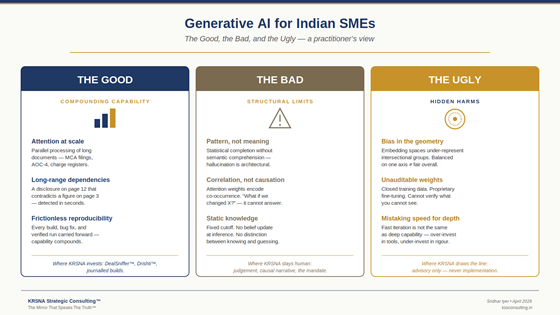
The core innovation of the Transformer — attention over all positions in parallel rather than step-by-step recurrence — is precisely what makes Large Language Models extraordinary at reading long, structured, messy documents. For a firm that spends its days with MCA filings, AOC-4 forms, Directors’ Reports, charge registers and related-party disclosures, this is not a theoretical benefit. It is the daily workhorse.
Our tools — DealSniffer™ and Drishti™ — use this capability to detect long-range dependencies that a human reviewer would need days to surface. A related-party disclosure on page 12 that does not reconcile with the revenue figure on page 3. A post-balance-sheet charge that reframes the debt story. Working capital that is mathematically correct but narratively impossible. These are the contradictions that turn a flat financial review into a real conversation with a promoter.
There is a second — less glamorous but more important — gain. David Donoho argues that the real driver of progress in applied machine learning is not emergent intelligence but frictionless reproducibility: the ability to share data, code, and outputs so that any practitioner can replicate, build on, and improve prior work. For a boutique firm, this is a discipline, not a deliverable. Every build of every tool, every bug fix, every verified run is journalled and carried forward. The capability compounds because nothing is allowed to evaporate.
The Ugly: hidden harms that quietly accumulate
The Oesterling et al. paper is the one that should unsettle enterprise buyers the most. It demonstrates, empirically and with an NP-hardness proof, that image retrieval systems optimised for proportional representation on individual demographic attributes — race alone, gender alone — systematically under-represent intersectional groups. Balance on one axis does not give you fairness overall. The distortion is in the embedding geometry itself, not in a superficial filter that can be patched.
For any organisation deploying AI in hiring, marketing, customer service or prospect identification, this embedded bias is a quiet legal and reputational liability. We are now stress-testing our own prospect pipeline against this question: across combinations of sector, geography, ownership structure and lifecycle stage, where are we systematically missing companies because our scoring functions optimise for what is easy to observe?
The second ugliness is opacity. Commercial LLMs arrive with closed weights, undisclosed training data and proprietary fine-tuning. You cannot audit what you cannot see. As the EU AI Act and India’s emerging DPDP framework mature, the auditability gap will become a compliance gap.
The third is the most human. It is the temptation to mistake speed for depth. Donoho’s point is that the pace of AI progress is largely the consequence of lowered friction to iterate on existing work — not the emergence of new reasoning capability. Firms that read the speed as capability will over-invest in tooling and under-invest in the rigour that actually drives sustained performance.
Where KRSNA draws its lines
KRSNA is, and will remain, advisory only — never implementation. Generative AI makes implementation feel cheap and fast. That is precisely the moment a practitioner must slow down and ask whether fast is the same as right. We use AI to prepare for conversations. We do not use AI to have them. We use AI to surface contradictions in a filing. We do not use AI to judge what they mean. We use AI to compound our own capability through journalled, reproducible practice. We do not use AI to replace the judgement that a promoter is paying us for.
The most durable frame from the readings, for a firm like ours, is Donoho’s: the organisations that will compound fastest are those that treat every output as something to build on. That is a practice, not a product. And it is the ground on which a boutique advisory firm can stand confidently against much larger competitors — because the compounding is a function of discipline, not of scale.
About the author
Sridhar Iyer is the Founder of KRSNA Strategic Consulting™, a boutique advisory firm serving unlisted Indian manufacturing, engineering and chemicals SMEs in the ₹50–500 crore revenue range. He is an alumnus of the Harvard Business Analytics Program, the Kellogg Growth Programme, the MICA SBMC and the IIM CFO Programme.