






Custody and Consequence
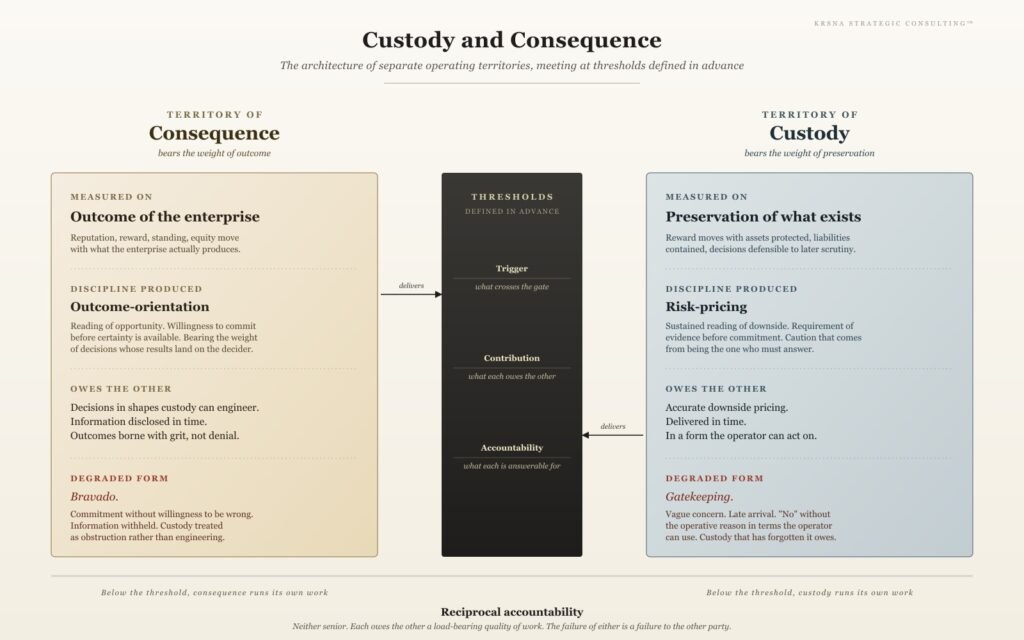
A structural account of why some enterprises produce outcomes and others produce only defensibility
Every sustained enterprise contains two disciplines that are designed to diverge.
One bears the weight of outcome. The other bears the weight of preservation.
A system that confuses them produces neither. A system that holds them, productively, produces both.
The argument that follows is structural. It is offered not as opinion but as observation of how systems behave when watched across time and across types. It is meant to be used.
The two disciplines
In any enterprise that operates over time, two distinct functions must be carried out by people, and the people carrying them are measured on different things.
The first is the bearing of consequence. Someone in the enterprise must be the person whose personal stake — reputation, reward, standing, equity — moves with the actual outcome of the enterprise. The discipline this measure produces is outcome-orientation: the willingness to commit before certainty is available, and to bear the weight of decisions whose results will land on the decider.
The second is the keeping of custody. Someone must be the person whose personal stake moves with the preservation of what already exists. The discipline this measure produces is risk-pricing: the sustained reading of downside, the requirement of evidence before commitment, the structural caution that comes from being the one who must answer when something goes wrong.
These are not personality types. They are roles, and the discipline each produces follows from what the role is measured on, not from the temperament of the person occupying it. The diagnostic question is never what kind of person is this? but what is this person measured on, and what happens to them personally when that measure moves?
The vocabulary of an enterprise frequently misleads. A finance officer may speak in custodial language while being measured, in fact, on whether deals close. An operating head may speak in consequence-bearing language while being measured, in fact, on whether anyone can fault the decisions made. The role’s discipline is determined by the measure, not by the language. The vocabulary deceives. The measure does not.
Why the disciplines must diverge
It is sometimes assumed that with sufficient communication, alignment, or shared purpose, the two functions could come to a common view. This is a misreading. The two disciplines are designed to diverge, and the divergence is the source of their value.
Each sees its own slice with extraordinary clarity and the other through cloudier glass. If the two roles agreed, the enterprise would not need both.
An enterprise that contains only one of the two disciplines cannot read its own situation. An enterprise that contains both, but does not hold them in productive tension, produces neither outcome nor protection. Only an enterprise that holds the divergence — productively and over time — produces both.
Reciprocity, not hierarchy
The most consequential error in conventional accounts of the custody–consequence relationship is the assumption that one discipline is senior to the other.
When custody is treated as senior, the enterprise loses its capacity to commit. Decisions slow until they are no longer decisions. Opportunity is read but not acted on. The enterprise drifts under the appearance of prudence.
When consequence is treated as senior, the enterprise loses its capacity to read downside accurately. Custodial warnings are filtered through the operating agenda before being acted upon, and the warnings that survive the filter are the ones that match what operating leadership already wished to hear. The failure, when it comes, is read as bad luck rather than as the structural absence of the discipline that was meant to price the downside.
The structural truth is more demanding:
Neither discipline is senior. Each owes the other a specific, load-bearing quality of work, and the failure of either is a failure to the other party — not a permission denied or granted.
The custodian owes the consequence-bearer accurate downside pricing, delivered in time and in a form the consequence-bearer can act on. A custodian who delivers vague concern, who arrives too late, or who can say “no” but cannot articulate the operative reason in terms the consequence-bearer can use is performing custody’s degraded form, which is gatekeeping. Gatekeeping is what custody collapses into when it forgets that it owes something.
The consequence-bearer owes the custodian decisions brought in shapes that custody can engineer, information disclosed in time for custody to do its work, and outcomes borne with grit rather than denial when they go against the bet. Commitment includes the willingness to be wrong in front of the custodian and to take the cost of being wrong.
The four failure modes
When the divergence is not held with reciprocal accountability, the enterprise produces one of four predictable failures. Each is recognizable. Each has its own internal coherence — that is, each is the system succeeding at what it is structurally rewarding, even when the outcome is poor.
The duel. Both disciplines present, both at full strength, neither cross-fluent in the other. Disagreements are honest, sustained, and personal. Each party experiences the other as the obstacle to their own work. The duel is the most visible failure mode and, paradoxically, sometimes the most recoverable, because the disagreement is named.
The deference. Both disciplines present, but one party has, over time, accepted a junior role and learned to yield gracefully. The yielding party is often praised for being “easy to work with.” The praise is the signal that the discipline has weakened. Cross-fluency, when present, produces productive disagreement, not absence of disagreement. An enterprise that has eliminated disagreement at the senior level has eliminated one of its two disciplines, regardless of how the organization chart reads.
The custodial monoculture. Only the custodial discipline is present. Every role in the system is structurally custodial. Custody has no consequence-bearer to deliver to, and so its quality drifts steadily toward whatever is most defensible — procedure followed, scrutiny avoided, decisions documented to a standard that will withstand later questioning. Outcome becomes residual. This is not a failure of leadership. It is the system succeeding at the only measure available to it.
The conditioned monoculture. The most lethal of the four, and the most often misdiagnosed. The system is structurally a custodial monoculture, but it has become accustomed to speaking the language of consequence. The reward gradient has not changed; only the vocabulary has. Verbal alignment masks behavioral resistance, and the masking is invisible to the people enacting it. They believe they support the outcomes they speak of. Their unconscious behavior continues to be shaped by the only measure that has ever operated on them. They block, delay, dilute, and neutralize — not through opposition, but through the slow operation of conditioned reflexes that are not visible to them.
This last mode is more lethal than the duel because the duel is honest. In the conditioned monoculture, the parties believe they agree, and the disagreement cannot be addressed because it is not in the room as disagreement — it is in the room as agreement that does not act.
The architectural reconciliation
Cross-fluency between two individuals is necessary, but not sufficient at scale. Beyond the role of two persons, the divergence is best held by an architecture that gives each discipline its own operating territory while maintaining reciprocal accountability across the whole.
The principle is straightforward to state, though demanding to design well:
Each discipline runs its own work in its own space. The two meet at thresholds defined in advance. At each threshold, each owes the other a specific quality of contribution. The ground of accountability across the architecture is reciprocal, not hierarchical.
In healthy mature enterprises, this architecture is recognizable in the unspoken rhythm of operations. Sales does not check with finance on every deal. Finance does not approve every operating decision. Both work to delegations, to thresholds, to documented criteria. When the threshold is crossed, the engagement is structured. Above the engagement, the disciplines part again, each running its own work.
In enterprises where the divergence is not held architecturally, every decision becomes a meeting between the two disciplines, and every meeting becomes a contest. There are no thresholds, and so there is no relief. The friction that should be reserved for the genuinely material is instead expended on the routine. The enterprise becomes exhausting to operate in, and the exhaustion is read as cultural friction when it is in fact architectural absence.
The point of singularity
The form of the enterprise — private or public, large or small, family-held or institutional — affects the difficulty of constructing this arrangement. It does not affect the necessity of constructing it.
A private enterprise that has not constructed it will fail in the same way a public enterprise will fail, though the path may be longer because the private enterprise has more degrees of freedom. A public enterprise that has constructed it — and there are some — will produce outcomes observers find improbable for the form, because the form is not the determinant. The architecture is the determinant.
Outcomes are produced when, and only when, the divergence between custody and consequence is held with reciprocal accountability — each delivering to the other what is owed — within an architecture that gives each discipline its own operating territory and meets at thresholds defined in advance.
A closing observation
The persons living within these structures are, almost without exception, doing what their measures and conditioning have shaped them to do. The custodian whose pricing of the downside is vague is not lazy — they are operating in a system that has not required them to deliver pricing the operator can act on. The operator who treats custodial input as obstruction is not arrogant — they are operating in a system that has not required them to bring decisions custody can engineer. The members of a conditioned monoculture who speak alignment they do not enact are not hypocrites — they are bearers of a conditioning they have never been asked to recognize.
Diagnosis from this framework, properly used, does not produce judgment of persons. It produces a clearer reading of structure, and from that reading, the possibility of structural change.
Custody and consequence are disciplines, not character. Both are necessary. Neither is senior. The work of an enterprise that wishes to produce outcomes is the work of constructing the architecture in which both can deliver to each other, at full strength, what each is owed.
The difference between an enterprise that produces outcomes and one that produces only defensibility is not in the persons. The difference is in the architecture, and the architecture is available to be built.
This is an abridgement of a longer paper of the same title. The full paper, including the diagnostic instruments and the four interventions corresponding to the four failure modes, is available on request.
KRSNA Strategic Consulting™ works with operators and custodians of unlisted Indian manufacturing, engineering, and chemicals enterprises on the structural questions on which sustained outcomes depend.