





Business Growth Through Data-Driven Decisions
Why instinct dominates when businesses grow
As businesses grow, decision-making becomes harder, not easier. Complexity increases. Data multiplies. More people influence outcomes. In this environment, leaders often fall back on what feels familiar.
Instinct.
This is not a flaw. It is a natural response. Most decisions in growing organisations are shaped by people deeply involved in day-to-day operations. Their experience is real. Their domain knowledge is hard-earned. Over years, this experience becomes intuition.
But intuition has limits.
When businesses cross a certain scale, the same instinct that once enabled speed begins to introduce risk. Patterns feel familiar even when conditions have changed. Assumptions go unchallenged. Decisions feel right, but are rarely tested.
This is where growth quietly starts to slow.
How bias enters without being noticed
In many MSMEs and even large enterprises, decisions are rarely made in isolation. They are influenced by teams closest to the work. Sales leaders defend their funnels. Operations leaders protect throughput. Finance teams focus on controls.
Each perspective is valid.
None is complete.
Over time, something subtle happens. Data begins to support opinions rather than challenge them. Metrics are selectively interpreted. Reports are adjusted to justify recommendations already formed.
No one intends to mislead.
But bias creeps in unconsciously.
When this happens, leaders are no longer deciding based on reality. They are deciding based on reinforced belief.
This affects everything.
Sales performance looks acceptable but hides margin erosion. Logistics decisions optimise cost but increase risk. Pricing changes drive volume but weaken long-term value. Supply chain decisions improve efficiency but reduce resilience.
The business moves forward.
But it does not compound.
The hidden cost of intuition-led decisions
Intuition-led decisions rarely fail immediately. That is what makes them dangerous.
They produce short-term wins. They feel decisive. They reward confidence. But over time, small errors accumulate. Missed signals compound. Opportunities are identified too late.
The cost of inaction is not dramatic failure.
It is gradual fragility.
Margins shrink quietly. Cash flow becomes unpredictable. Growth requires more effort for less return. Leaders sense discomfort but cannot isolate the cause.
At this stage, teams work harder. Meetings increase. Dashboards multiply. Yet clarity remains elusive.
This is where instinct becomes expensive.
Why data changes the quality of decisions
Data-driven decision-making does not remove judgement. It disciplines it.
Quantitative analysis introduces an objective lens. It forces assumptions to be stated. It exposes hidden variables. It challenges narratives that feel right but do not hold up.
When data is used properly, it does three things.
First, it validates or rejects assumptions. Leaders can see whether beliefs are supported by evidence or habit.
Second, it reveals patterns intuition often misses. Trends emerge across time, segments and scenarios that no individual can see alone.
Third, it reframes conversations. Decisions shift from opinion-based debate to evidence-led discussion.
This changes the quality of leadership dialogue.
Sales performance is analysed beyond top-line numbers. Logistics decisions consider variability, not averages. Pricing strategies are tested for elasticity, not just market positioning. Operational bottlenecks are diagnosed systemically, not anecdotally.
The business starts to see itself clearly.
Intuition is not the enemy
It is important to be clear.
We do not view intuition as the problem.
Intuition is built through lived experience. It captures nuance. It senses risk before numbers show it. In moments of uncertainty, it can be a powerful guide.
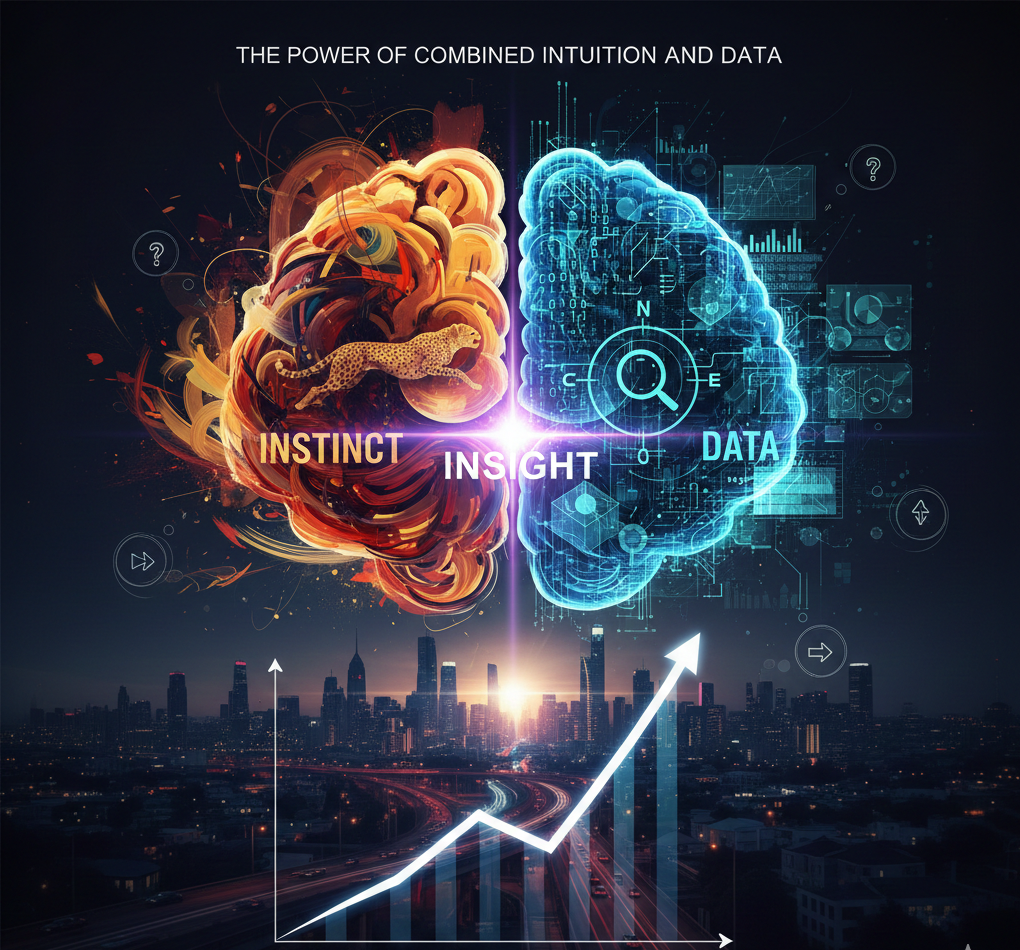
But intuition works best when paired with data.
Data provides structure. Intuition provides context.
When combined, leaders get the best of both worlds. Decisions become sharper. Confidence improves. Execution aligns faster.
Even when outcomes do not play out as expected, leaders know the decision was made on the strongest possible foundation.
That knowledge matters.
Moving from data availability to data usefulness
Most organisations already have data. What they lack is clarity.
Dashboards exist. Reports are generated. Metrics are tracked. But data often sits in silos. It answers operational questions, not strategic ones.
The shift required is not technological.
It is cognitive.
Leaders must move from asking, “What happened?” to asking, “Why did it happen?” and “What will happen if we choose differently?”
This requires structured analysis. Scenario thinking. Predictive modelling. And, most importantly, the willingness to let evidence challenge instinct.
This is where real transformation begins.
What changes when decisions are insight-led
When businesses shift from instinct-driven to insight-driven decision-making, several things change.
Decision cycles shorten because debates are grounded in facts. Accountability improves because assumptions are explicit. Strategy becomes clearer because trade-offs are understood.
Most importantly, avoidable errors reduce dramatically.
Not because leaders become perfect, but because uncertainty is managed consciously rather than ignored.
Growth becomes resilient. Execution becomes disciplined. Valuation improves because financial decisions are aligned with long-term value creation.
This is not about sophistication.
It is about clarity.
The shift that enables sustainable growth
For businesses aspiring to scale, growth does not begin with more activity. It begins with better decisions.
Moving from instinct to insight is not about rejecting experience. It is about strengthening it.
When leaders learn to combine intuition with clean, reliable data, they change how decisions are made across the organisation. Teams gain confidence. Boards gain visibility. The business gains resilience.
That is where sustainable growth starts.