






The lighter the business,
the bigger the residue
Why a business with no factory shows a much higher brand value,
and why that is a warning rather than a compliment.
In Part Two we valued the customer base of a mid-sized manufacturer, and the answer came out at nothing. The factory, the stock, the receivables and the trained people had already claimed the whole of the profit, and by the time the queue reached the customer relationship there was nothing left to give it.
Several readers asked the natural follow-up question. Does that happen to every business, or only to manufacturers?
It is a very good question, and the answer is instructive. Let us take the same method and apply it to a business built on completely the opposite principle.
A business with no factory at all
Consider a company that manufactures nothing. It buys finished goods from a third-party manufacturer, has them white-labelled under its own name, and makes its real money from the services it wraps around that product — specification, installation, commissioning, maintenance, training, whatever the category demands.
This model is extremely common in India today, across electrical products, instrumentation, laboratory equipment, medical devices, water treatment and dozens of other categories. The founder will usually tell you, quite correctly, that the product is available to anybody but the service is what customers actually pay for.
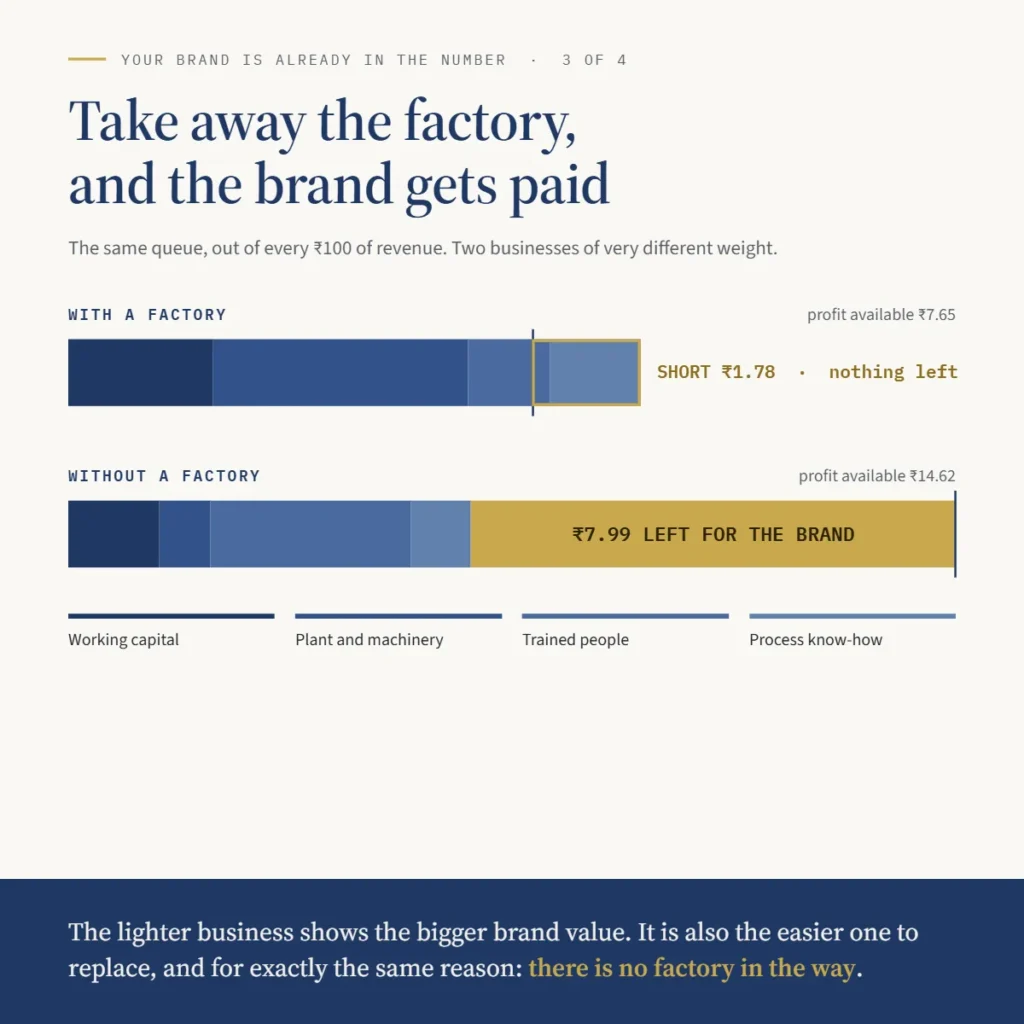
Let us say roughly sixty per cent of the revenue is product resale at a modest margin, and forty per cent is services at a much better one. Out of every ₹100 of revenue, after costs, depreciation and tax, ₹14.62 remains as profit. That is nearly double what the manufacturer had available.
The same queue, a very different shape
| Claim on the profit | With factory | No factory |
| Working capital | ₹2.38 | ₹1.50 |
| Plant and machinery | ₹4.20 | ₹0.84 |
| Trained people | ₹1.35 | ₹3.30 |
| Process know-how | ₹1.50 | ₹1.00 |
| Total claimed | ₹9.43 | ₹6.64 |
| Profit available | ₹7.65 | ₹14.62 |
Left for the customer relationship | −₹1.78 | ₹7.99 |
Three things have changed, and each of them is worth understanding.
- The claim from plant and machinery has collapsed from ₹4.20 to ₹0.84, because there is barely any plant to pay for.
- The claim for process know-how has fallen too, because the product technology is not even owned by this company. It belongs to the third-party manufacturer.
- The claim from trained people has more than doubled, and it is now the single largest item in the queue. In a services business the people are the delivery mechanism, so this is exactly as it should be.
The result is that ₹7.99 out of every ₹100 of revenue now reaches the customer relationship. Carried through the full calculation, the brand on this business is worth somewhere between one and nearly two times EBITDA, depending on how fast the existing revenue erodes.
On the manufacturer it was worth nothing at all.
Now please look again, because there is a sting in it
Most founders reading that table would feel quietly pleased to be on the right-hand side of it. I would ask them to slow down and ask one question.
Why did the manufacturer’s brand value come out at zero? Because the factory absorbed everything the business earned.
And why did this one come out so high? Because there is no factory to absorb anything.
But that same factory was also the thing standing between the manufacturer and his competitors. It took years to build, it took real money, and nobody can simply decide to have one next Tuesday. Remove the factory and you have removed the claim on the profit, and you have removed the barrier at the same time. You cannot have one without the other.
A measured brand value is not a moat. It is only what is left over after the assets have taken their share, and a business with fewer assets simply leaves a bigger leftover.
So the lighter business shows the bigger number and occupies the weaker position, and both of those facts have precisely the same cause. This is the single most useful thing in the whole series, and it is the reason I did not want to write only about manufacturers.
Two questions an investor will certainly ask
Neither of these appears anywhere in the calculation above. Both of them will decide what you are actually paid.
The first concerns your people. Your largest claim is now the trained workforce, which means the honest question is whether the value sits in your brand or in three or four individuals who deliver the service. If they resign, does the customer stay with you or follow them? Every investor knows this risk and most of them have been burned by it at least once.
There is a fair test, and I would recommend running it on yourself before anyone runs it on you. Step out of the pricing and delivery decisions for one full quarter and watch what happens to your realised prices. If discounting starts, the handover has not happened, however many years you have been at it. If the line holds without you in the room, it has.
The second concerns your supplier. You do not own the manufacturing. Your third-party supplier can begin selling directly tomorrow, or can white-label the identical product for your nearest competitor. The mark on the box is yours, but the plant behind it is not.
If your supply agreement is exclusive and long-dated, that is a genuine asset and it should be raised early and clearly. If it is non-exclusive or renews annually, you should expect to be asked, and you should have an answer prepared rather than discovering the question in the meeting.
What the white-label mark itself is worth
There is one more calculation worth doing here, and this is the only situation in the entire series where a second method genuinely applies.
Because the goods are bought in and then branded, there is an observable comparison available. You can see what the unbranded product costs and what you sell it for. That allows a relief-from-royalty calculation, which asks a simple question: if you did not own your own mark, what royalty would you have to pay somebody else to use theirs?
At a royalty of two to five per cent of product revenue, the mark on the box works out to roughly 0.2 to 0.4 times EBITDA. The customer relationships, as we saw, are worth one to nearly two times.
These two numbers measure different things and must never be added together. But the comparison tells you something the founder usually already suspects. The value is not in the label. It is in the service relationship behind it.
Where this leaves us
Across two very different businesses, the same method has produced two opposite answers, and in both cases the answer has pointed away from the line at the bottom of the valuation.
On the manufacturer, the brand computes to nothing because the assets have already been paid for what the brand brought in. On the service business, the brand computes to a great deal precisely because there are no assets standing in the way, which is also the reason the position is fragile.
In neither case is the right move to add a number at the bottom of the page.
So what is the right move? That is Part Four, and it is about what you actually do in the room: how brand evidence is used to argue the assumptions inside the buyer’s own model rather than to decorate your own, which is the only form in which any of this survives a serious negotiation.