






What your customers
are actually worth
The proper method for valuing a customer base, the answer it gives, and
why that answer is smaller than everyone expects.
Part One made a claim: brand value does not belong at the bottom of a valuation, because an earnings multiple already contains it.
The fair response to that is a question. Then what is a brand actually worth? There must be a number.
There is. There is a settled method for arriving at it, used in transactions every day, and it is worth understanding properly — not because the number it produces is useful to add to anything, but because of what the method teaches on the way.
I will give you the answer first, because it is the surprising part.
On a normal mid-sized manufacturing business, the customer base often values at nothing at all.
Not a small number. Nothing. Sometimes less than nothing.
A customer base that took twenty years to build, with relationships nobody can easily displace, can compute to zero on a method that valuers accept without argument.
That result is not a flaw in the method. It is the method telling you something true, and once you see what, the whole question of brand value in a negotiation changes shape.
Why the method is a subtraction
The technique is called the multi-period excess earnings method. The name is the explanation.
A customer relationship cannot be observed earning anything by itself. No invoice ever says: of this amount, so much is because they already knew us. There is nothing direct to measure.
So instead of measuring it, you isolate it. You take everything the existing customers generate, and then you subtract a fair return to every other asset that helped generate it. Whatever is left over is what the relationship itself earned.
Hence excess earnings. The brand is the residue.
The seven steps
One. Define the base narrowly.
Revenue from customers who exist today. Not total revenue, not projected revenue, not the pipeline, and certainly not what you hope to win next year.
Customers acquired after the valuation date belong to the buyer’s effort, not to the asset being sold. This is where most enthusiastic estimates go wrong at the very first step: the temptation is to value the business and call it the brand.
Two. Decay the base.
The existing book shrinks over time. You need a survivorship curve, and you need to be careful which attrition you are measuring.
Logo attrition — how many customers leave — is almost always flattering. Revenue attrition — how much money leaves — is worse and lumpier, because a customer can stay on your books while quietly moving three-quarters of its volume elsewhere.
Derive it from your own history on a same-customer basis. Then run it again excluding your largest account. One growing customer will mask decay across everything behind it, and if retention looks excellent with your biggest account in and poor with it out, you do not have a retention story. You have a concentration story, and the two are valued very differently.
Three. Apply the right margin.
Not blended company margin. The margin on the existing book specifically, which is usually better, because serving a qualified customer costs less than winning a new one.
Then step down from EBITDA to EBIT by charging depreciation, because the assets wear out whether or not the relationship continues.
Four. Tax it.
Post-tax operating earnings. Nothing subtle here.
Five. Charge the contributory assets.
This is the step people skip, and it is the step that makes the number honest.
The customer relationship does not earn alone. It sits on top of working capital, plant, a trained workforce, and whatever process capability lets you make the thing at all. Each of those is an asset in its own right, and each is entitled to a fair return before you attribute anything to the relationship.
Skip this and you credit the customer relationship with earnings that belong to your factory.
Six. Discount it.
At a rate above the business’s own cost of capital, usually by two to four points. A customer book is riskier than the business as a whole, because it is the part most exposed to a single decision taken by somebody else.
Seven. Consider the tax amortisation benefit, then usually set it aside.
In an asset purchase, the acquirer can amortise the intangible and that has value. In a share subscription, which is what most growth rounds are, it generally does not arise. Claiming it in the wrong structure is an easy thing to be caught on.
What it produces
Take ₹100 of revenue from existing customers on a mid-sized manufacturer. A 16% EBITDA margin on that book, depreciation at 5.8% of revenue, 25% tax.
That leaves ₹7.65 of post-tax operating earnings.
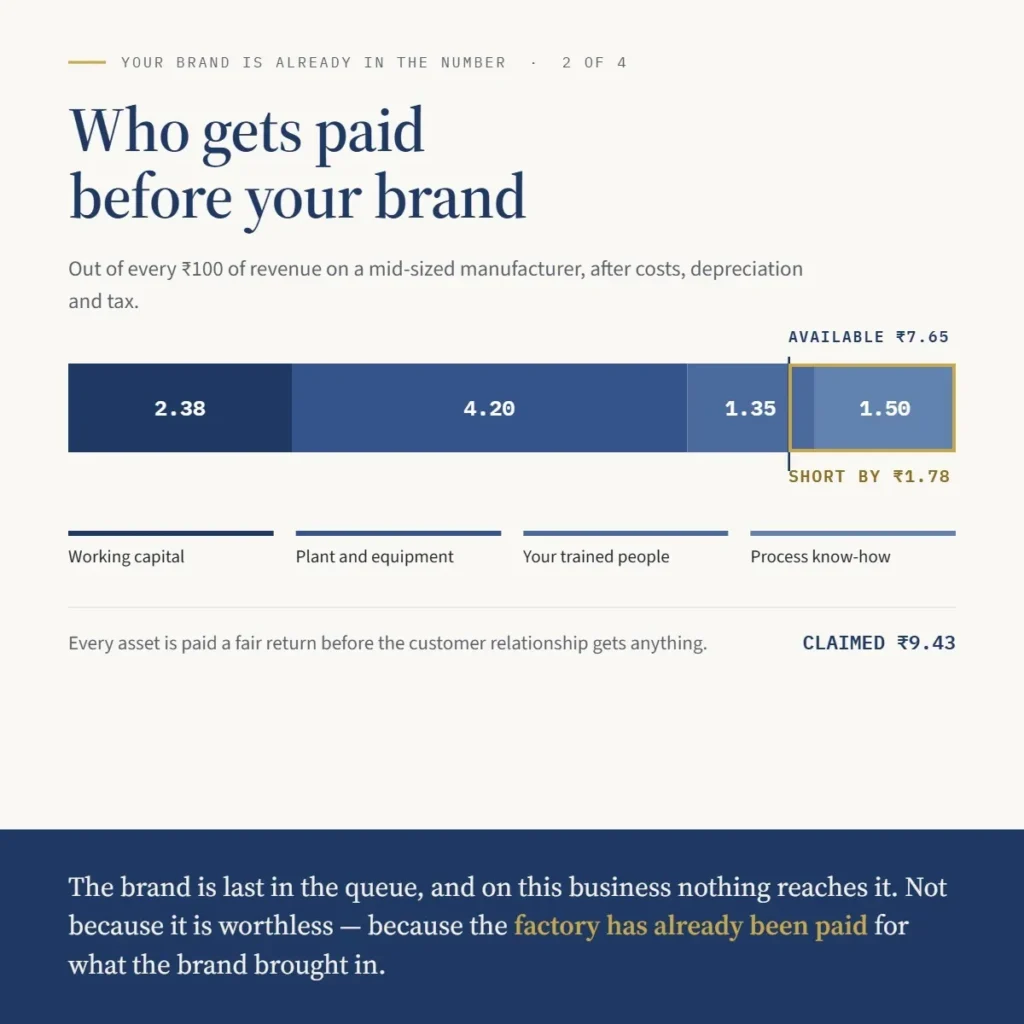
Now the queue. Working capital at 28% of revenue, earning 8.5%. Fixed assets at 40% of revenue, earning 10.5%. A trained workforce whose replacement cost is 9% of revenue, at 15%. Process capability at a royalty equivalent of 1.5%.
Claim on the earnings
| Claim on the earnings | Per ₹100 revenue |
|---|---|
| Working capital | ₹2.38 |
| Plant and equipment | ₹4.20 |
| Trained workforce | ₹1.35 |
| Process know-how | ₹1.50 |
| Total claimed | ₹9.43 |
| Available | ₹7.65 |
| Left for the customer relationship | −₹1.78 |
Nothing reaches the end of the queue. The customer relationship is short by ₹1.78 on every hundred rupees of revenue.
This is a real and well-known outcome. Valuers who meet it handle it by shortening the asset’s life, arguing a margin premium on the existing book, or concluding that there is no separable customer intangible to recognise at all.
What the zero is actually telling you
It is not telling you the relationships are worthless. Read the arithmetic again.
The customer base came out at nothing because the earnings it produces have already been fully claimed by the factory, the stock, the receivables and the people.
The brand was never a separate asset sitting beside the plant. The brand is the reason the plant has orders.
Which is the same conclusion Part One reached from the other direction, now arrived at by arithmetic rather than argument. A founder who adds brand value at the bottom of a valuation is not merely counting the same money twice. He is claiming payment for something the assets in his own business have already been paid for.
The fragility nobody mentions
Now change one input and leave everything else alone.
EBITDA margin on the book
| EBITDA margin on the book | Value of the intangible |
|---|---|
| 13% | effectively nil |
| 16% | around 0.7× EBITDA |
| 19% | around 1.1× EBITDA |
A six-point margin movement swings the answer roughly tenfold.
That happens because the excess earnings are a thin sliver left over after the contributory asset charges. Move the margin a little and you are not moving the sliver a little; you are moving it proportionally enormously. The decay rate and the discount rate matter too, but nothing like this.
Two things follow. Anyone presenting a customer intangible as a single confident figure has not understood what they are holding — it is a range, and a wide one. And if a small margin change swings this tenfold, consider what the same change does to the valuation of the whole business, where the margin runs across every future year rather than a decaying book.
The number worth taking away
It is not the intangible. It is the decay rate.
Work through all seven steps and the most valuable thing you end up holding is an evidenced, defensible view of how fast your existing revenue base actually erodes.
If yours erodes at 6% a year and the buyer’s model assumes 15%, that difference is worth many times the intangible you were planning to append. It runs through every forecast year and straight into terminal value, which on most transactions is the majority of the number being argued over.
The method does not give you something to add. It gives you an assumption you can prove.
Which is the first genuinely useful thing brand evidence can do in a negotiation, and it is the subject of Part Four.
What comes next
Part Three takes this same method to a business with no factory at all — one that buys finished goods and sells services around them — and finds something counterintuitive. The lighter the business, the larger the measured intangible, and the weaker the position.
Those two facts have the same cause, and the reason is worth a part of its own.