






What was sold.
What was not.
Why brand value does not belong at the bottom of a valuation
— and what it cost me to learn it the other way round.
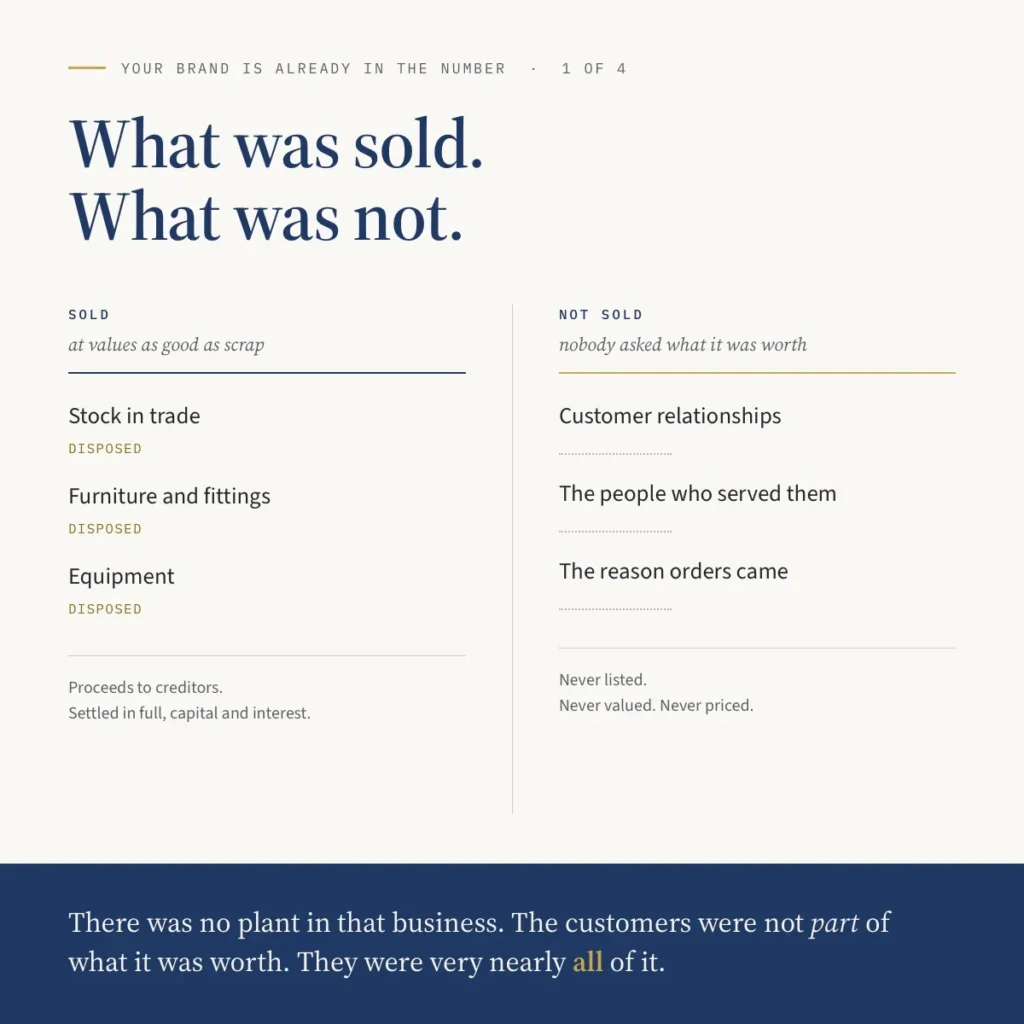
At the end of it, I sold the stock at scrap.
That is the accurate word, and I have never found a softer one that was also true. Not a discount. Not a distress price. The market reads the opportunity and the market is unforgiving, and what went out of that warehouse went out at values I would be embarrassed to set down here. The proceeds went to creditors. Every rupee was settled in the end, capital and interest, nothing written off by anybody. That part I am at peace with and always have been.
What I am not at peace with is what nobody sold, because nobody thought to.
There are two numbers in every negotiation, not one
This is the whole idea, and everything else in this article follows from it.
The first number is intrinsic value. It is what your cash flows are worth to anybody at all, arrived at through an earnings multiple or a discounted cash flow. It is reasonably objective, it is where a buyer begins, and it behaves like a floor.
The second number is strategic value. It is what your business is worth to the particular person sitting across the table, and it contains something no model can see. It contains the years that buyer does not have to spend, because you have already spent them.
The difference between these two is the gap.
Your brand does not change what the business is worth. It changes what the business is worth to one particular buyer, and the size of that difference is what your brand actually determines.
Once you see the negotiation this way, a great deal becomes clear. The meeting is not an argument about what your company is worth in the abstract. It is a quiet argument about who gets to keep the gap. The buyer would prefer to pay the floor and keep the whole of it. You would prefer to be paid most of it. Everything else is detail.
Why a discounted cash flow cannot see the gap
A discounted cash flow values what a business will earn. It has nothing whatsoever to say about what a buyer skips by not having to build it. These are two different quantities, and only one of them is in the model.
The clearest illustration in Indian business history is the sale of Thums Up.
In 1993, Ramesh Chauhan sold Thums Up, Limca and Gold Spot to Coca-Cola for roughly sixty million dollars. At the time Thums Up held somewhere around eighty-five per cent of the Indian cola market. Coca-Cola could not have built that position in a decade at any price, because what was actually on sale was fifteen years of a market’s habit, which money alone does not buy.
What followed is instructive. Coca-Cola initially tried to suppress Thums Up in favour of its own flagship, discovered that the consumers who left simply went to Pepsi rather than to Coke, and had to reverse course and revive the very brand it had bought in order to bury. Today Thums Up is the only billion dollar brand in Coca-Cola’s India portfolio.
Now notice the clause that appears in almost every such transaction. A non-compete. Chauhan’s ran for fifteen years.
Nobody pays a man to stay out of a business unless they believe that what he would rebuild has real value. The non-compete is the buyer’s own written admission that the gap is there.
I would add one practical point about that clause, because founders routinely give it away. The non-compete should be priced as separate consideration, not thrown in free. If a buyer requires five years of your absence from the market you built, that absence has a value and you should be paid for it. A seller who signs it without consideration has handed over an asset and received nothing in return.
The other side of this, which I did not want to hear
I should record the counter-argument fairly, because it is strong and because it corrected me.
A finance-minded reader would say that brand is not an asset at all. It is an effect. The only evidence a brand exists is that customers pay more, stay longer, or cost less to acquire, and all three of those are already in the earnings. Awareness scores and sentiment surveys do not survive contact with a discount rate.
Most of that is correct, and the first three parts of this series rest on it.
But it misses something that anyone who has actually built a market will tell you. Somebody had to create the demand in the first place. A product nobody has been given a reason to want is simply inventory, and inventory is what gets sold at scrap. Marketing is what carries a product from the plant to the person who will pay for it, and then determines how much that person will pay, which is never a matter of cost plus a margin.
In fact the two positions meet at an uncomfortable place. Excess earnings exist in the first place only because somebody refused to price at cost plus margin. Work through the arithmetic of Part Two with a cost-plus business and the residue is zero by construction, because the assets take their return and nothing is left behind them. What the method measures is the accumulated deposit of years of pricing courage. If nobody ever drew a line in the sand at the point of sale, there is no brand value to argue about later, and the finance position becomes trivially correct.
So how is the gap actually claimed?
Not by adding a line to your own page. By arguing the assumptions inside the buyer’s model.
This is the single most practical thing in the series, and it is the difference between evidence that works and evidence that gets declined in one sentence.
| What you can evidence | What it argues in their model |
| Realised price above the category | Your margin assumption, not the category average |
| Revenue retention better than the norm | A lower decay rate, which moves terminal value most |
| Repeat orders won without heavy spend | Your growth rate, without their sales budget |
| Approvals, validations, switching costs | A different comparable set altogether |
It is the same evidence and the same underlying work. Only its position in the room has changed.
A line at the bottom of your page is something the other side can decline in a sentence. A changed assumption inside their own spreadsheet is something that, once accepted, moves the number by itself without your having to ask again.
Two things that matter more than the arithmetic
Offer a range, never a single figure. A point estimate invites an attack line by line, and the moment one component is successfully challenged the whole number looks unsafe. A range with the assumptions openly named lets you concede an assumption instead of conceding the number, which is a far cheaper thing to give away.
And prepare for their method before you enter the room. Where a counterparty wants a lower figure, they will generally reach for a cost-based approach, asking what you actually spent building the brand, or for a multiple applied to your weakest recent year. Both produce smaller numbers and both are entirely predictable. Having the rebuttal ready is worth considerably more than another decimal place in your own model.
Where this series began
I started Part One with a business I closed many years ago. I sold the stock at scrap, I settled every creditor to the last rupee, and nobody in that process, least of all me, put any price at all on the customers.
There was no factory in that business. By everything set out in Part Three, the customer relationships were not a component of its value. They were very nearly the whole of it, and the whole of the gap went for nothing, because I did not know that there was a gap to be sold.
I could not see it because I was sales, services and technical, and all three of those seats face outward. They teach you to win the customer, deliver the work and build the product. Not one of them teaches you to read what you own.
I learned the other discipline two decades later. The thing it would have saved was long gone by then, which is precisely why I have written these four parts.
Marketing builds the gap. Finance measures the floor. Neither of them can price a deal on its own, and a founder who understands only one of the two will leave money on the table without ever knowing it was there.
That is the end of the series, and I am grateful to everybody who argued with me through it. The arguments made it better.
“`