





Every Brand Problem Is a
Hiring Problem
Why value erodes one interaction at a time, how to tell whether it is happening in .
your company this week, and why the fix starts at the interview table.
Every brand problem I have been asked to look at eventually turns into a hiring problem.
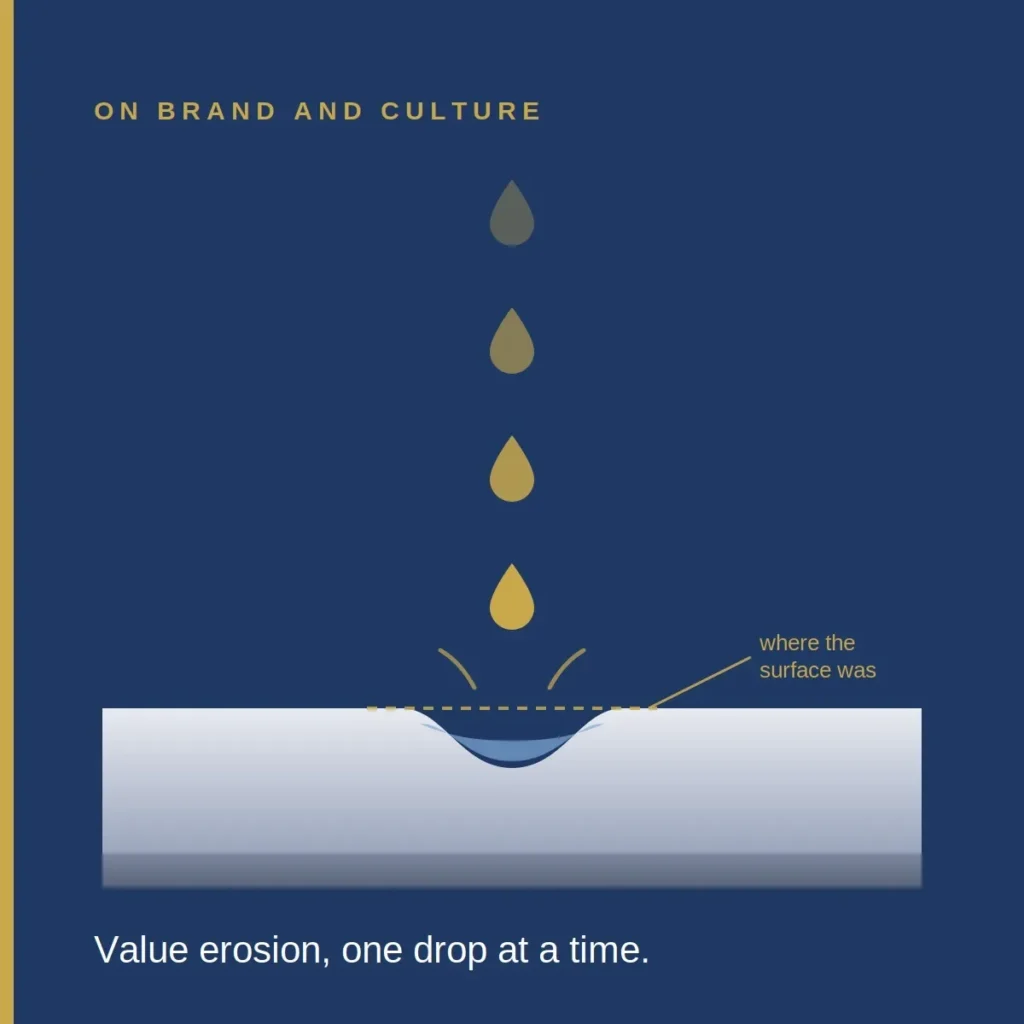
A professor of mine said something fifteen years ago that I have never been able to put down. A brand endures only if every interaction ends in resolution. Every customer, every employee, every vendor, every time. A single transaction that ends badly is not a service lapse. It is value erosion, drawn from the same account the marketing budget is trying to fill.
I heard it then as a customer service point. I understand it now as an operations problem, and finally as a culture problem. The distance between those three readings is most of what this article is about.
The damage that never looks like damage
Erosion is the right word, and it is worth taking literally. Water falling on stone does not break it. It wears it, in increments too small to register, and the surface looks intact right up until someone measures it against where it used to be. Nobody in the building watches the drop land. There is no incident, no escalation, no meeting.
This is the first reason it goes unnoticed. The second is structural. Nobody inside your company is thinking about the brand. They are head down in their own operations, doing the job in front of them, and doing it conscientiously. Operations is delivering. Accounts is reconciling. Service is closing tickets. Each function can hit its number in a month during which the customer’s actual experience got materially worse, because no single function owns the sum of the interactions. The sum is exactly what the customer is buying.
The third reason is that most measurement systems record closure, not resolution. A complaint marked closed on the seventh day tells you nothing about whether the customer got what they needed on the second, or gave up asking on the sixth. Closure is a fact about your system. Resolution is a fact about the customer. Companies that confuse the two are usually the last to know they have a problem.
The bar you never agreed to
Here is what makes this harder than it was when my professor said it.
Your customer is not comparing you to your competitor. They are comparing you to the best experience they had all week, from any brand in any category. They tracked a parcel that morning to the hour. They cancelled something in two taps. They got a refund before they finished explaining. Then they call your office at three in the afternoon about an order and are told someone will check and revert.
The comparison is unfair and it is also unavoidable. Expectation is formed across categories and spent in yours. The bar moves and nobody circulates a memo. A business that benchmarks only against the two rivals it has competed with for twenty years is measuring against a bar that stopped rising a decade ago.
Against those odds, the firms that clear it anyway build something a competitor cannot copy, discount against, or poach. Not because the standard is clever, but because sustaining it is genuinely hard and most people will not do it for long enough. That is the moat. Grit, held for years, is a defensible asset precisely because it cannot be bought in a quarter.
Tools on one side, fewer names on the other
It is tempting to believe this is a problem for one kind of business rather than all of them. It is not. It applies at every size and in every industry, and the two halves of the market simply fail at it differently.
In consumer businesses the volume is enormous, so the answer has been instrumentation. Sentiment models read reviews and call transcripts at a scale no team could. Ticketing systems route, escalate and time-stamp. Dashboards turn a million interactions into a number a board can look at. All of this is genuinely useful, and none of it resolves anything. A model can tell you, by Tuesday, that a customer is angry. It cannot be the reason that customer stops being angry. The tools detect and they route; a human being at the end of the chain still decides whether the customer leaves the exchange whole. Every rupee of technology in the stack ultimately reports to that decision.
Business-to-business firms have the opposite condition and take a false comfort from it. The customers are few enough to name. You can list them on one page, you know who to call, and measurement therefore looks easy. It is easy. That is the trap. Easy to measure is not the same as easy to correct, and concentration cuts the other way: when you have twelve accounts rather than twelve lakh, a single unresolved interaction is not a rounding error, it is a material share of next year’s revenue sitting in a room where someone is deciding whether you are still worth the trouble. Add to that the fact that each of those accounts is not one relationship but eight or ten people, each forming their own view of you, and the number of interactions per customer is far higher than the customer count suggests.
Neither side escapes. One has the tools and forgets the human. The other has the visibility and mistakes it for control.
Friction is the word for it
Strip both halves down and the same thing sits underneath: friction. Every unresolved interaction is friction the customer had to absorb on your behalf, and every brand that lasts has, in practice, made itself easy to do business with. Not cheap. Not clever. Easy.
Two experiences, from opposite sides of the table.
The first. I ordered something from one of those global houses whose name is a byword for customer satisfaction, the firm other firms benchmark themselves against. I paid in full, upfront. The item mattered to me. The first two days were flawless: confirmation, tracking, a delivery date I could plan around. On the third day I found the order had been cancelled. Not delayed. Cancelled, unilaterally, with no reason given. When I went looking for one, the system politely advised me to contact the vendor directly. I sourced the item elsewhere and lost the days.
Nothing dramatic happened. Nobody was rude. Every metric in that chain almost certainly closed green. But a company that spent a decade and a fortune earning the benchmark position lost it with me in a single automated line, and the loss is invisible to them, because I never complained. I simply know something now that I did not know before. That is what erosion looks like from the inside of the customer.
The second was smaller and, in its way, worse. A delivery refused at the building, left in the lobby, for no reason anyone bothered to offer. One person deciding that the last twenty metres were not their problem.
Now the other side of the table. A customer of ours was preparing a launch intended to define its category, and was tight on budget. What we were selling was priced above a million dollars. The chief executive asked us directly: how can you help? We did not blink. Pay two hundred thousand now, and the balance when you have a million customers on the product. The deal closed in under ten minutes.
The terms are the least interesting part of that story. What we actually sold him was a smaller risk. He was betting a category-defining launch on a product that could not yet be proven, with a budget that could not absorb being wrong, and we took that risk off him and onto ourselves, where it was better judged. Ease of doing business is not politeness, and it is not paperwork. It is the removal of whatever the customer is otherwise being asked to carry alone.
Which is also why this is not an argument for generosity. Pricing against a customer’s risk rather than your own product only works if you can absorb the downside and you genuinely believe the thing will earn out. Do it without either and you have simply moved the erosion onto your own balance sheet.
And it only works if someone in the room can say so while the customer is still sitting there. Ten minutes is not a negotiation; it is what happens when authority sits where the customer is standing. The same offer, requiring three approvals and a fortnight, is not the same offer. Every version of this story I have watched fail, failed that way — the person facing the customer had to carry the question somewhere else, and by the time an answer came back the moment had closed and the goodwill with it.
Which surfaces the question hiding underneath all the dashboards. Everyone inside is chasing something: closure rates, cycle times, cost per order, tickets per agent. Where is the human in all of it? The two stories above differ in exactly one respect. In the first, a system executed correctly and no person was present. In the second, a person was present and permitted to act.
Resolution, not perfection
A fair objection, and one worth meeting head on: the service literature says a failure handled well often earns more loyalty than no failure at all. That is true, and it does not weaken the argument. It sharpens it.
The word doing the work is resolution, not perfection. A complaint that ends resolved is a good interaction — sometimes the best one you will have with that customer all year, because it is the only moment they see how you behave under pressure. What erodes value is the interaction that ends unresolved, or that ends resolved only because the customer chased it for three weeks.
So the diagnostic question is never “how many things went wrong”. Things will go wrong; you are running a business. The question is what happened after.
A diagnostic you can run this week
None of the following requires a consultant, a survey instrument, or a budget line. It works in a company of forty people and in a company of forty thousand, because in both cases you are sampling the same thing. All of it requires that you be willing to hear the answer.
Be your own customer. When did you last order from your own website, or call your own helpline without announcing who you are? Most heads of business have never done it, or did it once, years ago, with someone watching. Do it this week. Pay with your own card. Count the friction — every field you fill twice, every screen that answers a question you did not ask, every point at which the process assumes you will simply cope. That is your brand, as experienced rather than as reported.
Follow one complaint end to end, by date rather than by status. Pick a closed one at random from last quarter. Lay out the actual dates: first reported, first substantive response, resolved, confirmed by the customer. Most people find one gap they cannot explain. That gap is where the drop lands.
Count the chases. On that same complaint, count how many times the customer had to initiate contact after the first report. Zero or one is healthy. Three or more means your system resolved nothing; the customer’s persistence did. Track this number across ten cases and you have a better brand metric than any satisfaction score.
Ask the person who answers the phone what they are allowed to decide alone. Not what they should do — what they may do, without asking anyone. If the honest answer is “nothing”, then every interaction in your company is queued behind a manager’s calendar, and your customers are experiencing that queue as indifference.
Read the last fifty messages in your service or operations group. Not for the problems. For the tone, and for how often a thread ends without anyone confirming the customer is actually alright.
Ask a recent hire, at ninety days, what they were told at the interview and what they found. They still remember both, and they have not yet learned that it is impolite to mention the difference. In six months they will have stopped noticing. This is the single highest-yield conversation available to anyone running a business, and it costs twenty minutes.
Read exit interviews of the front line, not the managers. People who leave a service desk or a counter describe the culture as customers experience it. People who leave a corner office describe the culture as it is discussed.
If three or more of these come back uncomfortable, you do not have a service problem. You have a hiring and standards problem that is currently being paid for out of your brand.
Why the posters do not work
You cannot poster your way past any of this. “Customer obsession is our way” on the wall of every room is a silent reminder at best. It changes nothing that is not already true, and where it is not true it does active harm: every employee who reads it while being told to close the ticket and move on learns that the company’s stated values are decorative. That lesson generalises fast, and it is expensive to reverse.
Culture is not declared. It is hired, and then it is defended in the small decisions — who gets promoted, which shortcut gets tolerated, what happens the first time somebody chooses the customer over the monthly number and it costs the company money. Your people are reading those decisions far more carefully than they read the wall.
The question at the interview table
Which brings it to the beginning, where it belongs.
Most companies prepare a list of questions for the candidate and no honest answer to the candidate’s question: why should I work here?
For most businesses, the answer is not salary. You will usually lose that comparison and you should stop competing on it. What you have, if you have built it, is different and more durable: decisions that take hours rather than quarters. Direct access to the person who owns the business. Breadth — a young hire here will touch product, customer, operations and commercial in the same year, which a larger employer will not allow for a decade. And the one that matters most for everything above: when you tell us a customer needs something, you will be believed, and you will be allowed to act.
That is a real offer. It is also a promise with teeth, because a candidate who joins on it and finds it false becomes, within a year, the employee who ends interactions unresolved. The offer and the erosion are the same mechanism, running in opposite directions.
If you can say it honestly, say it at the interview table. If you cannot say it honestly yet, that is the work — and it is worth more than anything the marketing budget could buy this year.