





Grab Holdings — The 14-Year Road to Breakeven
Southeast Asia's Superapp: Conviction, Capital & the Flywheel
$10.4B
Total Capital Raised
12 Yrs
To First Profitable Quarter
8 Countries
Southeast Asia Footprint
1. Origin & The Founding Bet
Grab began in 2012 as MyTeksi — a simple, safety-focused taxi-booking app in Malaysia launched by Harvard Business School classmates Anthony Tan and Tan Hooi Ling. The founding insight was mundane but powerful: Southeast Asian cities were large, fragmented, and underserved by formal transport infrastructure. Within two years the company had rebranded as Grab and was expanding across Singapore, the Philippines, Thailand, and Indonesia.
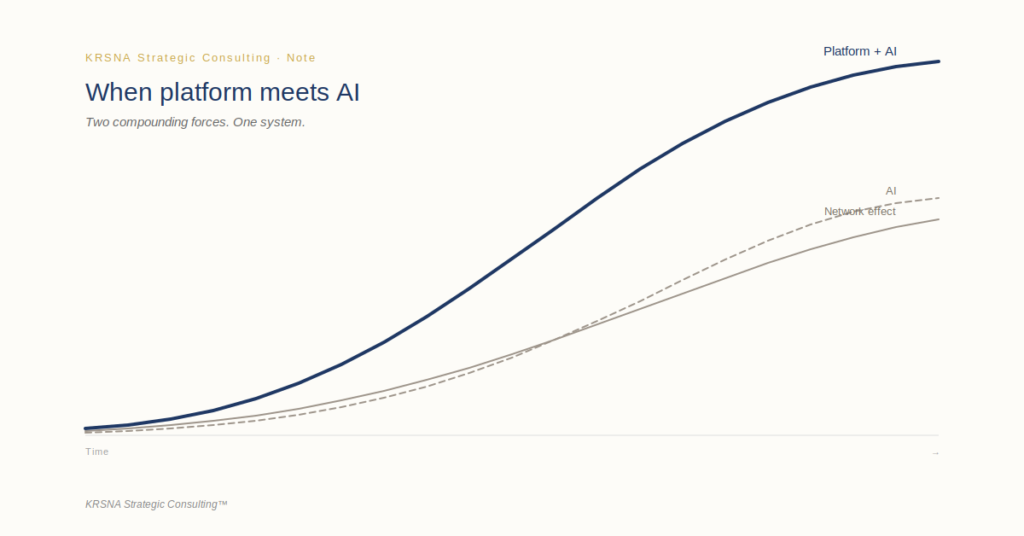
From the outset, the founders were not building a taxi app. They were building a platform — one that could eventually route any on-demand service through a common driver network and a single consumer interface. This distinction would define every subsequent capital raise, product extension, and strategic decision for the next decade.
In March 2018 the thesis was validated spectacularly: Grab acquired Uber’s entire Southeast Asian operations, with Uber taking a 27.5% stake in Grab in exchange. This single move removed the most dangerous Western rival and crystallised Grab’s regional dominance.
2. How They Stayed Afloat — The Capital Machine
The blunt answer is deep pockets — but with structure, conviction, and strategic logic behind every round.
The Funding Cascade
Grab raised $10.4 billion across 32 rounds from 106 investors before reaching profitability. The investor roster reads like a geopolitical map of parties who needed Southeast Asian mobility exposure: SoftBank Vision Fund, Toyota, Hyundai, Microsoft, Booking Holdings, Ping An Capital, Temasek, BlackRock, Fidelity, T. Rowe Price, and Morgan Stanley.
The pivotal moment was SoftBank’s entry. Masayoshi Son reportedly told Anthony Tan directly: “Anthony-san, you take my money. It’s good for you. It’s good for me. If you don’t take my money, not so good for you.” The SoftBank Vision Fund alone injected $1.46 billion in the 2019 Series H round, bringing that single round to over $4.5 billion. SoftBank’s playbook was consistent across its portfolio — flood the dominant regional player, force rivals into unsustainable burn, and prepare for IPO.
The SPAC IPO — Replenishing the War Chest
In December 2021 Grab listed on the Nasdaq via the largest SPAC merger in history. The deal delivered approximately $4.5 billion in fresh cash, anchored by a $4 billion private investment from BlackRock, Fidelity, T. Rowe Price, Morgan Stanley’s Counterpoint Global, and Temasek. This injection arrived precisely when post-COVID expansion was straining the balance sheet hardest, providing runway to continue the platform build-out while rivals struggled.
Key Milestones
2012
Founded as MyTeksi in Malaysia by Anthony Tan and Tan Hooi Ling.
2014
Series B–C rounds; Tiger Global, GGV Capital enter. Pan-SE Asia expansion begins.
2016
SoftBank Group enters at Series F. Honda also invests. Platform diversification accelerates.
2018
Acquires Uber's SE Asian operations. Launches GrabFood, GrabPay, GrabExpress.
2019
Series H closes at $4.5B+. SoftBank Vision Fund leads with $1.46B. Toyota, Hyundai, Microsoft co-invest.
2021
Nasdaq SPAC IPO — largest in SE Asian history. ~$4.5B cash received.
2022
Sets Group Adjusted EBITDA breakeven target for H2 2024. 1,000+ job cuts begin.
2023 Q4
First-ever profitable quarter: $11M net profit. Breakeven brought forward
2024
Full-year adjusted EBITDA of $313M — 70% above initial guidance.
2025
Revenue guidance $3.33–$3.40B. EBITDA margins swing from -38% to +69% year-on-year.
3. Where They Stand Today — The Turnaround Is Real
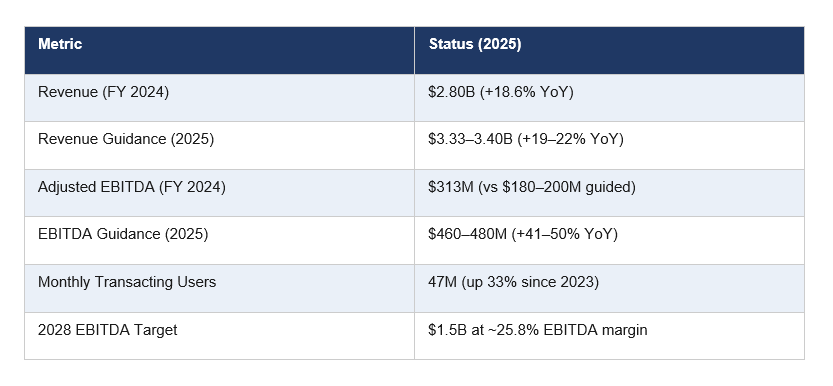
The financial trajectory has shifted decisively. Full-year 2024 revenue reached $2.80 billion, up 18.6% year-on-year, and 2025 guidance points to $3.33–3.40 billion — a further 19–22% increase. More telling is the EBITDA swing: EBITDA margins moved from -38% in Q2 2024 to +69% in Q2 2025 in a single year. Management has set a 3-year target of 20% revenue CAGR through 2028, with 2028 adjusted EBITDA of $1.5 billion — a 200% increase from 2025 levels, implying a 25.8% EBITDA margin.
The Flywheel That Finally Spun Up
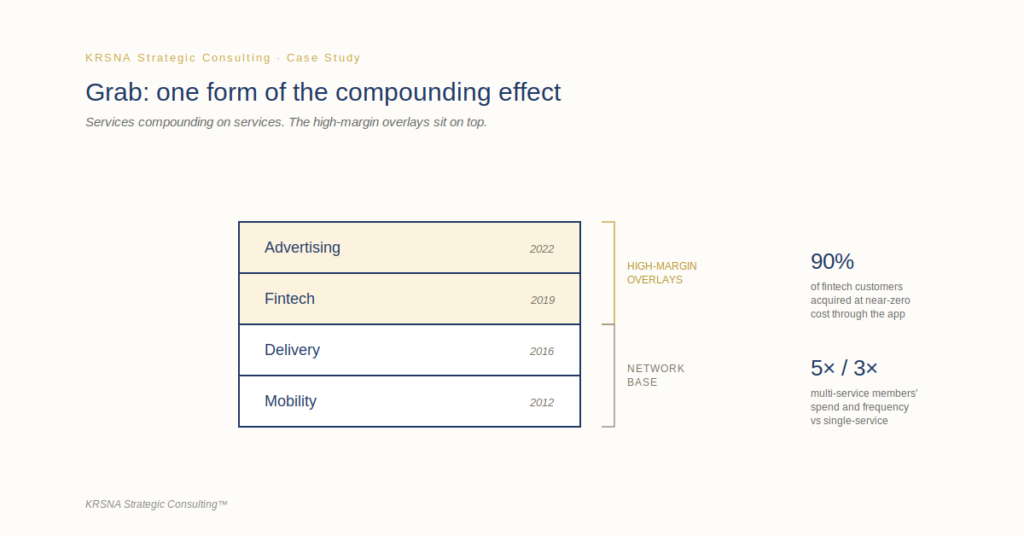
The most powerful indicator is what happens when users adopt multiple services. GrabUnlimited loyalty members spend 5× more and order 3× more frequently than non-members. The company currently penetrates only 6% of Southeast Asia’s population — the runway is almost untouched.
The fintech arm is emerging as the highest-margin layer. Of GXBank’s customers, 90% were acquired at near-zero cost through the Grab app itself — a textbook illustration of the flywheel: the consumer platform funds the financial services customer base, and financial services revenues flow back into the platform. Advertising within the delivery segment surged 60% year-on-year in 2024, with 228,000 active merchant advertisers.
4. Key Learnings — What This Story Teaches
The Grab story is more than a capital deployment story. Several structural lessons emerge for any operator building a platform business — or advising one.
L1
Market size must justify the burn — and you must own the category.
The thesis was not speculative. Southeast Asia's 650 million population was genuinely underpenetrated by formal services across transport, food delivery, payments, and credit. The burn was rational only because the platform, if it survived, would be irreplaceable infrastructure. Size of prize determines acceptable loss period
L2
Single-vertical economics rarely survive. Platform economics do.
Ride-hailing alone could not have justified $10B in losses. The insight was that a driver network doubles as a delivery network, and a delivery user is also a lending prospect and an insurance buyer. Revenue per user compounded across verticals while marginal cost per transaction fell. Single-vertical rivals — those who tried to compete only in food or only in rides — could not replicate this.
L3
Profitability came from discipline, not just volume.
The actual inflection point was not a GMV milestone. It was the 2022–2023 pivot to cost control: 1,000+ job cuts, share-based compensation reductions, elimination of loss-making product lines, and an end to indiscriminate consumer subsidies. Growth-at-all-costs thinking was abandoned. The lesson: capital efficiency is a strategic choice, not just a financial outcome.
L4
The high-margin businesses are layered on top of the low-margin entry point.
Rides and food delivery are structurally low-margin (1.8–4% EBITDA on deliveries). They are the customer acquisition engine. Advertising, fintech, subscriptions, and insurance are the actual profit pool. 90% of GXBank customers were acquired at near-zero cost through the app. Advertising revenue grew 60% YoY. The founding business was a trojan horse for a financial services company.
L5
Strategic capital has a different ROI equation than financial capital.
Toyota, Hyundai, Microsoft, and Booking Holdings did not invest for yield. They invested for optionality — fleet electrification, mapping, digital travel, and payments infrastructure. This explains why Grab could raise at valuations that pure financial logic could not support. For capital-intensive platform businesses, strategic investors extend runway beyond what financial investors alone would tolerate.
L6
SoftBank's playbook — and its shadow side.
Masa Son's capital was instrumental. But it also inflated expectations, sustained unprofitable competitors via their own capital pools (GoTo, Sea), and created a market structure where the war of attrition lasted far longer than it needed to. Deep pockets bought time. They also bought competitors time. The lesson: dominant capital does not guarantee rapid victory in winner-takes-all markets when multiple players have access to the same capital pools.
5. The Advisory Lens — Relevance for Indian SMEs
The Grab story resonates in a different register when viewed through the lens of Indian manufacturing and engineering SMEs. The structural parallels are instructive even when the scale differs by three orders of magnitude.
Most Indian SME founders who have survived long loss periods — or extended low-profitability periods — have done so on promoter conviction and informal capital: family loans, deferred vendor payments, reinvested working capital, and personal guarantees. There was no SoftBank. The discipline question is identical, however: at what point does conviction become a liability without a credible path to cash generation?
Three questions from the Grab story are worth internalising for any SME advisory engagement:
- Is the market large enough that dominance, once achieved, justifies the losses incurred to get there? Many Indian SMEs lose money defending a niche, not building a platform. The calculus is different.
- Are there high-margin overlay businesses that can be layered once the core customer relationship is established — financing, service contracts, data, or training? The core product is often the trojan horse, not the prize.
- Is the promoter choosing loss extension out of conviction in a structural thesis, or out of inertia? One is a strategy. The other is a spiral.
Grab’s story is ultimately about patience and architecture: the patience to let a platform compound, and the architectural discipline to build the high-margin businesses on top before the low-margin ones run out of road.
6. Terminology Explained
Two terms that appear repeatedly in Grab’s story — Series H and SPAC — deserve a plain-language explanation for readers who are not steeped in venture capital and capital markets.
What Does ‘Series H’ Mean?
Series H is simply the name of Grab’s eighth major institutional funding round. It has nothing to do with hedge funds.
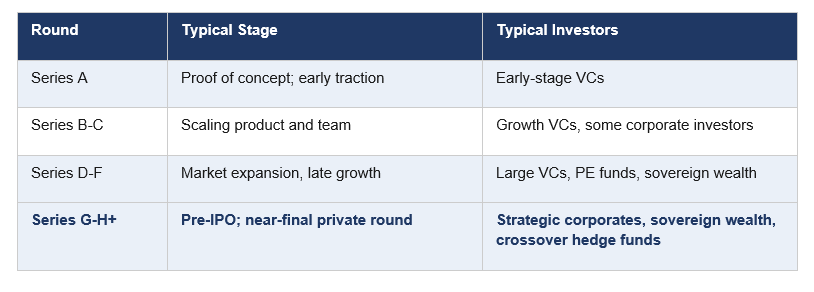
Startup funding rounds are labelled alphabetically — Series A, B, C, D, E, F, G, H and so on. Each letter marks the sequence of the round. Earlier rounds (A, B) tend to be smaller, earlier-stage investments made by venture capital firms when a company is still unproven. Later rounds (F, G, H) are typically much larger, made at much higher valuations, by a broader mix of investors including growth equity funds, sovereign wealth funds, corporate strategic investors, and sometimes hedge funds as crossover investors.
By the time a company reaches Series H, it is generally a late-stage business approaching IPO readiness — which was exactly Grab’s position when its $4.5B+ Series H closed in 2018–2019. The investors in that round — SoftBank, Toyota, Hyundai, Microsoft, Ping An, Booking Holdings — were not primarily financial return seekers. They were strategic investors buying optionality in Southeast Asia’s mobility and payments infrastructure.
What Is a SPAC IPO?
SPAC stands for Special Purpose Acquisition Company. It is best understood as a shell company with no business operations — just cash — that lists on a stock exchange first, and then goes looking for a private company to merge with and take public.
Traditional IPO vs SPAC
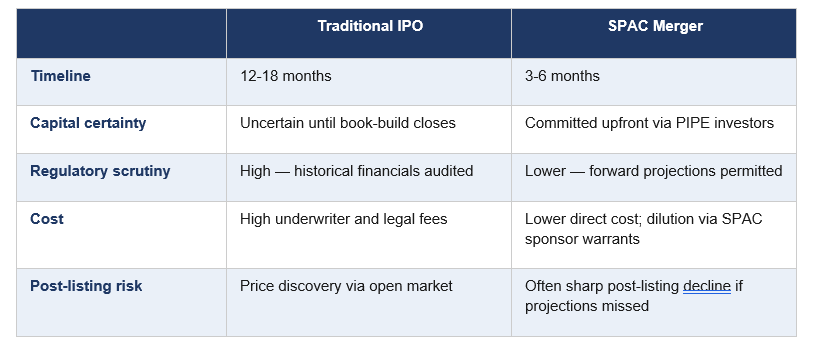
In a traditional IPO, a private company goes through a long, expensive process — audits, roadshows, regulatory filings, underwriter negotiations — and lists directly on an exchange. It can take 12 to 18 months and costs tens of millions in fees, with no guarantee of pricing or investor reception.
In a SPAC merger, a promoter — usually a respected investor or banker — raises a blank cheque fund, lists that fund on the exchange first, and then approaches a private company: merge with my already-listed shell, and you are instantly public. The private company bypasses most of the traditional IPO process, receives committed capital upfront, and can make forward-looking projections that traditional IPO rules would restrict.
Why Grab Chose the SPAC Route
By 2021 Grab was burning cash heavily, market conditions were volatile, and a traditional IPO would have been slow and uncertain. The SPAC merger with Altimeter Growth Corp allowed Grab to lock in $4.5 billion in committed cash upfront via a structure called a PIPE — Private Investment in Public Equity — anchored by BlackRock, Fidelity, T. Rowe Price, Morgan Stanley, and Temasek. Speed and capital certainty were the two decisive advantages.
The Shadow Side
SPACs became enormously popular in 2020-21 and then fell sharply out of favour. The structure allows companies to go public using optimistic forward projections that traditional IPO scrutiny would have challenged more rigorously. Grab’s shares lost roughly 75% of their value from the December 2021 listing price before the business fundamentals eventually recovered.
The lesson: SPAC was a legitimate tool for a specific purpose — capital certainty and speed to listing under volatile conditions. It was not a substitute for building a profitable business. The market’s eventual judgement was on the fundamentals, not the listing mechanism.