






The Account Is Not the Logo
Why winning a company means winning three pillars of power — and why two of them are built to stay out of view.
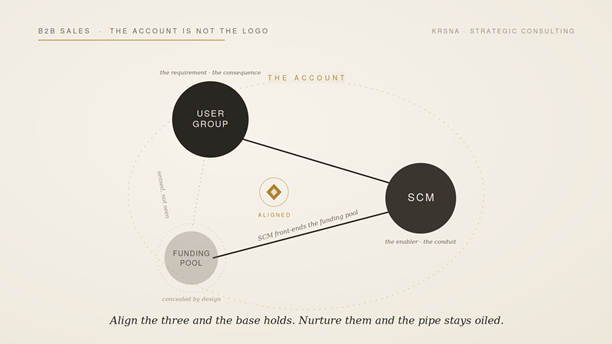
When a salesperson says they have won the account, they almost always mean they have won the logo. The contract carries a company name. The CRM records a closed-won. The buyer’s organisation chart is pasted into the account plan as if it were a map of the territory.
It is not. It is a map of authority. And in complex B2B selling, authority is rarely the same thing as consequence.
The organisation chart tells you who signs and who reports to whom. It does not tell you who will live with the outcome long after you have left the room, and it does not tell you who is quietly enabling — or quietly blocking — the decision from inside. Over close to four decades of carrying a number in industrial, engineering and process selling, I have come to read every buying organisation, whatever its size or sector, as three pillars of power. The account is the alignment of those three. The logo is only the envelope they happen to arrive in.
What follows is how I read each pillar, how each is mishandled, and what it takes to align all three — because a sale that rests on a single pillar is not a sale. It is a hope wearing the costume of one.
The first pillar — the user group
At the centre of every serious purchase sits the user group, headed by a powerful person. These are the people who will actually consume the product or service. They feel the absence of it most sharply, and so they are almost always the movers of the requirement — the ones who decide that something is needed and who cause the requirement document to be written. They may be technical enough to write it themselves, or they may call in the technical department to draft it on their behalf.
This is where the most common and most expensive misreading happens. The people who write the requirement are not the power. Wherever they sit in the structure, the drafters of a specification carry no skin in the game on the vendor or the project. They will not be measured on whether the chosen solution performs. They are not the consequence-bearers. The head of the user group is. He is the one whose line stops, whose output slips, whose name is attached to the decision when it is reviewed a year later. That is what makes him — not the drafter, however helpful and however fluent — the first pillar.
A seller who courts the requirement-writers and mistakes their accessibility for influence has befriended the most available people in the building and the least decisive. Worse, he has often been handled: a specification can be shaped, before you ever arrive, around a competitor’s strengths or around a solution that has already been informally chosen. The requirement document is therefore not just a brief. It is evidence. Read who wrote it, how specific it is, and whose language it speaks, and you learn a great deal about where the consequence already sits and whether the contest is real or already settled.
The work at this pillar is simple to state and hard to do: reach past the drafter to the head, understand what outcome that person is personally accountable for, and sell to the consequence rather than to the convenience.
The second pillar — the SCM team
The second pillar is supply chain — the procurement and contracting function. They are the enablers of the decision, and they occupy a dual position that sellers consistently underestimate: they are partly custodian and partly consequence-bearer.
Unlike the requirement-writers, the SCM team has genuine skin in the game, and it runs the full arc — from the selection of the vendor through to the execution of the project. They hold custody of the process by which the choice is made: the comparison, the audit trail, the defensibility of the decision if it is ever questioned. And they carry the consequence of having chosen, because a vendor who fails in execution becomes, inside the organisation, SCM’s failure as much as the user group’s.
This dual nature explains what SCM actually wants from you, which is rarely what the inexperienced seller offers. They are not, at heart, hunting for the lowest number, whatever the opening posture suggests. They are hunting for a recommendation they can stand behind — one that survives scrutiny, that will not embarrass them in eighteen months, that they can defend to the people above and behind them. The seller who arms SCM with a clean, defensible basis for choosing him has not cleared a hurdle. He has recruited an ally with standing inside the rooms he cannot enter.
Treat SCM as a toll gate and you will be priced like a commodity at the gate. Treat them as a pillar — a party with custody and consequence of their own — and they become the most reliable carrier of your case through the parts of the decision you never see.
The third pillar — the funding pool
The third pillar is the funding pool, with finance sitting inside it. Their stake is two steps removed, and that distance is deliberate. They rarely show their hand. You sense them more than you see them — they sit, by design, about three steps back from visibility, and they are generally front-ended by SCM, who speaks on their behalf and absorbs the first contact on their terms.
The mistake is to read invisibility as absence. The funding pool is the most concealed of the three pillars and frequently the most decisive when crossed. They are not evaluating your product; they are evaluating risk — the risk that the spend does not return, that the project overruns, that a cheaper certainty was available and not taken. Their question is rarely “is this the best solution?” It is “is this the most defensible use of capital, and can the people recommending it be trusted to have de-risked it?”
You will almost never argue your case to the funding pool directly. This is the central difficulty of the third pillar: the argument that wins it is made in a room you are not in, by people who are not you. Which means your real task is to equip the user group and SCM to win that argument on your behalf — to give them the risk-language, the certainty, and the second-order reassurance that finance is listening for. Sense the funding pool through the questions SCM relays back to you; those questions are finance’s fingerprints. Answer them before they are asked twice, and you have addressed a pillar you may never meet.
The three pillars of the account. Align them — and the base holds.
The discipline: alignment, then nurture
The account, then, is not a name. It is the alignment of three pillars — the user group, SCM, and the funding pool. Get those three aligned and you have covered your base; the decision can carry weight without collapsing. Win only one of them — usually the user group, because they are the most visible and the most welcoming — and what you have is a champion with no enabler and no funder. That is not a sale. It is a hope wearing the costume of one.
Alignment is a state, not an event. The three pillars move at different speeds and care about different things: the user group about outcome, SCM about defensibility, the funding pool about risk. A proposal that satisfies one can unsettle another — a specification rich enough to delight the user group can read as over-engineered and expensive to finance. Part of the craft is composing a single case that each pillar can read in its own language and find sound.
I have watched a deal close in a first meeting — the senior man saying yes, everyone leaving satisfied — and then go nowhere for nine months, because the working head of the user group, the person who would actually run what we sold, had never been brought along. He had no authority to refuse. He had every ability to withhold his assent slowly, and he did. The signature sat in one pillar; the consequence in another; and the two were never aligned. The logo had been won. The account had not.
And alignment, once achieved, is not self-sustaining. Nurture the three pillars patiently — long before a specific deal and long after it — and the pipeline stays well-oiled, opening doors you did not have to force, because the relationships were already warm when the next requirement formed. Neglect them between deals and even a won account silts up, until you are once again a stranger pitching to a specification someone else has already shaped.
Where to enter
If the three pillars decide together, where should the seller begin? Usually with the user group, because that is where the requirement is born and where consequence is felt most plainly — but only if you climb past the drafter to the head. From there you earn the right to be carried to SCM as a serious candidate rather than a cold one, and through SCM you begin to sense the funding pool. Entering through SCM alone risks being processed as a commodity; entering through finance is rarely possible, and when it happens it often means the user group has not yet been engaged and the requirement is not yet real. The order is a guide, not a rule. What is not optional is that all three are eventually aligned.
The account beneath the logo
The reason all of this is hard to see is that two of the three pillars are built to stay out of view. The funding pool conceals itself by design. SCM front-ends it. And the user group’s true power often sits below its most visible name. Reading the real structure asks for something the closing seller — narrowed by urgency to the person who can say yes — does not have: the exteriority of the witness, the willingness to watch how an organisation actually decides before trying to make it decide.
Sell to the logo and you have addressed none of the three pillars. Read them — the consequence at the centre, the custodian who enables, the funder who hides — align them, and then nurture them past the close, and the logo becomes what it always was: a formality, signed once the real account has already said yes.