





Why Your Channel Business Is Growing — But Not Compounding
A recap of my session at ISODA's Friday Connect Series, Episode 37 — 5 June 2026.
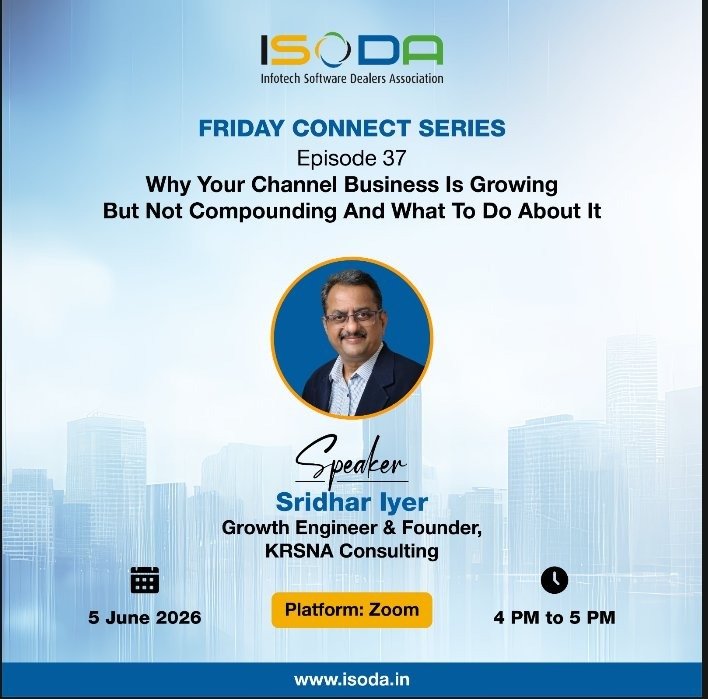
On Friday I had the privilege of spending an hour with the ISODA community — the Infotech Software Dealers Association — for Episode 37 of their Friday Connect Series. The room was full of channel, SaaS and VAD founders, and I opened with a contract: no pitch from this stage. I have sat in their chair — carried the sales bag, run the P&Ls, lived inside a principal’s program, and rebuilt a venture from zero. What I came to offer was four levers and three questions. The work, as always, stays theirs.
This is the spine of that hour.
The feeling most founders can’t name
Most of the room had a good year. Revenue up, team busy, pipeline full — and a quiet sense of running harder just to stay in the same place. That feeling has a structure, and it is worth saying out loud:
Revenue is moving, but margins are flat. The principal decides your quarter through programs, rebates and allocations. Your top customers are ambivalent — they would switch for a slightly better price. Busy is not the same as compounding.
Before going further, one honest reframe. We tend to call them “vendors.” They are the principal. You are the dealer, and you live inside a program someone else writes. That single word — principal, not vendor — changes how everything after it lands.
Growth doesn’t start with activity. It starts with the seed.
The instinct under pressure is to do more — more outreach, more SKUs, more campaigns. But an undefined identity is an uncontrolled growth path. When you don’t know what the business is, you say yes to everything, and value leaks out the back while the top line still rises. Direction and momentum feel identical from the inside. They are five years apart in outcome.
I asked the room three questions to test whether the seed is set. What is this business, actually? Beyond the money — which is table stakes — what is the second driver that keeps you in the chair when margins compress? And the most pertinent one most founders never ask aloud: are you in the right market?
The clearest illustration of a seed that never moved is Ball Corporation. A $200 loan in 1880 became kerosene tins, then the world’s largest maker of glass canning jars, then an aerospace pivot that put hardware on satellites, and finally the world’s number-one aluminium can manufacturer. The form changed beyond recognition — tins to spacecraft. The identity, containment, never moved. One seed, 140 years. Even the decision to exit glass was the same logic telling them when to concentrate, not just expand.
The commodity trap
If the honest answer to “are you in the right market?” is a commodity market, the arithmetic turns uncomfortable. Volume rises while margin erodes, and the two curves cross — you work harder for revenue that carries less and less profit. In a pure commodity channel, price is set by the market and your cost by the principal; your margin is the thin sliver in between, and it only gets thinner. Typical profit tops out around 5%. The box is a pass-through. If value isn’t created somewhere else, there is no value.
So what do you do about it? In a commodity market, exactly two roads survive: differentiate, or have a great price. The first road is harder and durable; the second is honest and brutal. Most of the hour was the first road — across four levers.
Four levers out of the trap
Differentiation. Two companies I advised arrived with the same complaint — “price is dictated by the market, I have no choice.” To a steel trader convinced price was his only lever, I said: absorb one step of your customer’s process — cut-to-drawing, kitting, grade advice. You’re no longer selling steel; you’re keeping their line running. To a second-generation NBFC founder about to pour money into digital marketing, I said: that buys comparison-shoppers who leave for 25 basis points — leverage the trust you already have, and own a community rather than a campaign. The principle underneath both: move one step up the chain, stop selling the box and sell the outcome around it. And a warning for this AI moment — AI equalises the generic. If your differentiation can come from a prompt, it isn’t differentiation. For most channel businesses, the fastest road out is customer centricity: depth and trust the principal cannot replicate. Don’t fall in love with the first big deal — the customer who stays ten years is worth a multiple of the one you fought hardest to land.
Cost as a strategy. Most firms use cost for exactly one thing: cost plus margin equals price. That is the narrow view. The strategic question is different — at what cost structure is value actually delivered to the customer? Read each cost line not as a number but as a hypothesis about how you compete. Material cost asks whether you have the pricing power to absorb a shock. Finance cost asks whether your debt enables the strategy or constrains it. “Other expenses” asks what is being hidden. Read the cost structure and you read the strategy. I shared one disguised case of a business running two operations as one, where no one could say which costs belonged to which — a hidden star carrying costs that weren’t its own, and a hidden drain shedding its true costs onto the other. Without knowing what costs what, you can pour resources into the wrong asset entirely.
Data over instinct. Picture a firm much like yours: 200 customers, ₹76 crore on the book. What is the average customer worth? Divide, and you get ₹38 lakh. Simple question, simple answer — isn’t it? But the mode is ₹4 lakh and the median is ₹9 lakh. Mode below median below mean. The mean overstates the typical customer; the median is honest. The top twelve accounts carry 60% of the revenue. Report the mean and you have already misled yourself about the business you are running. Mean ₹38 lakh, median ₹9 lakh — two different companies, and only one is real.
Risk. That same concentration is where risk already sits in your books. Twelve customers carrying 60% of revenue is a twelve-customer business with 188 attached — and the exposure runs both ways, sell-side and the principal’s buy-side. Value-at-Risk is a useful way to see it, as long as you treat it as history, not prophecy: line up your last 250 trading days worst to best, and a 95% one-day VaR is simply the line below which your loss stayed 19 days out of 20. Its blind spot is the twentieth day — the tail it never sees, where the loss isn’t marginally worse but the top account walks or the large order is cancelled. LTCM in 1998 is the cleanest lesson: the math wasn’t wrong, the math assumed normal — and a tail event the models treated as near-impossible destroyed the smartest people in the room. So start risk at the window, not the spreadsheet: scan what’s already changing, play it forward, and only then put a number on it.
One farmer who lived every lever
The case that tied it together comes from an industry you would never expect. A process engineer with an entrepreneurial streak left his job mid-career; the business he built collapsed in COVID. With his family’s security gone, he returned to the land — not chasing a market, but following a duty he’d inherited from his father and grandfather: help our villagers.
Two cows became a flywheel. The by-products were the business: milk to fodder waste to biogas to manure to subsidy to organic ghee — three kilograms a month, rising to ten and climbing. When the ghee became marketable, KRSNA stepped in on branding, packaging, pricing, positioning and the fodder economics. He had moved up the chain by instinct; this is where it became deliberate. Then one more habit — capture the data — and what instinct never could do, the data did. Soil testing, satellite imagery, seed coating, university research, all feeding an AI platform: cluster farming with buy-side and sell-side economics, the curve still climbing. His own words: “Happy for now. More to achieve.” If a farmer can do this, what is our excuse?
What you take home
I closed where every compounding business starts — with what you decided to be. Ball held one identity across 140 years; a farmer found his in a few seasons. The seed governs both the expansion and the pruning. And I left the room with three questions — to answer not in their seats, but on Monday:
- Do you have direction, or just momentum? And a reason to be in this market beyond the money?
- If you stopped competing on price tomorrow, what would your top customers still pay you for?
- If your largest principal changed its program next quarter, what happens to your business?
My thanks to ISODA for the platform and to a generous, sharp room that did the hard thinking out loud. As I said at the close: I show possibilities. The work is yours.