





Sākṣin: The Question Behind Digital Transformation

For at least a decade, mid-market businesses have been told that the path to competitive durability runs through digital transformation. The advice has been confidently delivered. Consulting firms have built large practices around it. Software vendors have repackaged it as their core narrative. Business schools have woven it through their curricula. Promoters have been told, in many forms and from many directions, that they must transform digitally or perish.
The result has been substantial investment and surprisingly little durable advantage.
A great many businesses have spent meaningful capital on digital transformation programmes — ERP modernisation, CRM rollouts, e-commerce channels, data lakes, analytics platforms, RPA initiatives, and more recently, generative AI deployments — without producing the strategic outcomes the investments were meant to produce. Some delivered operational efficiency; many did not even deliver that. Few shifted the underlying competitive position of the business in any way that lasted.
It is worth asking why.
The Three Levels Where the Standard Story Operates
The standard story about digital transformation actually operates at three different levels that are usually conflated, to the detriment of clear thinking.
At the first level, digital transformation means adopting digital channels and tools. Websites, apps, e-commerce, CRM, ERP. Real efficiencies, but limited — nothing about adopting them changes the underlying business.
At the second level, it means re-engineering business processes around digital capabilities. Workflow automation, predictive maintenance, demand sensing. More meaningful operational improvements than the first, but still within the existing business model. The business does the same thing it always did, just faster.
At the third level, digital transformation is described as a paradigm shift — a wholesale change in how value is created and captured. Become a platform. Build a network effect. Adopt an AI-first architecture. This is where the consulting industry’s most ambitious claims sit. The vocabulary is grand. The results, in mid-market businesses, are mostly absent.
Why “Level Three” Transformations Almost Always Fail
The honest observation, after a decade of attempts, is that transformation at the third level rarely succeeds when attempted by incumbent businesses. The handful of celebrated examples — Netflix’s pivot to streaming, Amazon’s launch of AWS, Walmart’s data infrastructure — turn out, on close inspection, to be diversifications rather than transformations. Netflix did not transform DVD-by-mail into streaming; it built a structurally separate streaming business. Amazon did not transform retail into AWS; it built a structurally separate cloud business. Walmart did not transform itself into a data company; it built data infrastructure alongside its retail operation.
The pattern is consistent: durable strategic advantage at the third level is achieved by building something new alongside the existing business, not by transforming the existing business into something else. This is a strategic move that has existed in the management literature for decades. It is called diversification, not transformation. The use of the word “transformation” obscures this distinction and produces predictable failure when promoters attempt to literally transform their existing operations into something they are not.
For most mid-market businesses, the implications are stark. They cannot become Netflix. They cannot become AWS. They cannot become a platform. Their markets are too concentrated, their capital too constrained, their talent too scarce, their existing operations too consequential to abandon. The third level of digital transformation, as commonly described, is structurally unavailable to them — and the advice that they should pursue it has wasted years of attention and capital.
The Question Behind the Question
The deeper question almost no one is asking is this:
Is your business legible to itself?
Before any conversation about platforms, network effects, AI architectures, or strategic diversification can be productive, a more foundational question must be answered. Does the business know what data it has, where it lives, what its operations actually generate as observable signal, what its customers and suppliers and employees and machines are telling it through their daily interactions? Is the business visible to itself, or is it operating largely on instinct, accumulated experience, and the partial views available to senior people who are themselves consumed by daily execution?
For most mid-market businesses, the answer is that they are not legible to themselves. The data exists, scattered. The touchpoints exist, but many are not capturing data, or are capturing it in forms that cannot be analysed. The signals are present, but they are not being received. And without legibility, no strategic move — digital or otherwise, ambitious or modest — can be made well, because the business is moving without being able to see itself move.
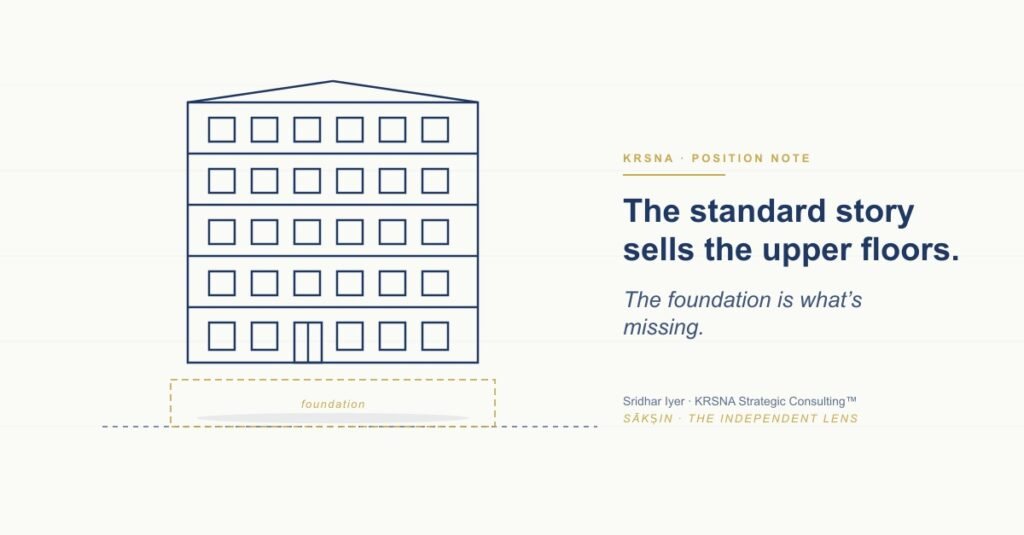
This is the gap the standard story has missed. It has sold the upper floors of the building to businesses that had not yet poured the foundation.
The Sākṣin Position
The work that actually needs to be done first is, by comparison, unglamorous. It is the work of looking. Looking at what is there. Looking at what is missing. Looking at what is leaking. Looking, with discipline and from a position of independence, at the business as it actually is, rather than as it is imagined to be by the people who are too busy running it to see it clearly.
This work cannot be done by the operators themselves. The promoter, the CFO, the sales head, the operations head — all of them are by structural necessity heads-down in the running of the business. The cognitive load of execution leaves no room for the contemplative, pattern-seeking work that real strategic insight requires. The very thing that makes operators valuable to the business — their absorption in it — disqualifies them from seeing it from outside.
The Vedantic tradition has a word for the role this work requires. Sākṣin — the witness, the observer-consciousness who sees without being implicated. The independent observer whose function is to see what the operator structurally cannot see.
The work of the Sākṣin is not consulting in the conventional sense. It does not produce methodologies. It does not deliver implementations. It does not promise standardised outcomes. It is something older and, in some ways, more difficult. It is the disciplined practice of looking, applied to one specific business at a time, in that business’s irreducible particularity.
This is the work KRSNA Strategic Consulting does.
“The argument is developed further in a follow-up position note — Disruption Is Real. The Diagnosis Is Incomplete. — which addresses where conventional prescriptions for disruption fall short and what the alternative actually looks like. The full architecture of the position, including the structural claim and what the practice asks of those who engage with it, is set out in a whitepaper, Sākṣin: The Independent Lens, available on request from the sequel article.”
For promoters and CFOs of unlisted Indian manufacturing and engineering SMEs in the ₹50–500 Cr revenue range who have invested in digital transformation and not seen the durable advantage they expected, the conversation worth having is not about the next technology to adopt. It is about whether the foundation has yet been poured.
That conversation, KRSNA exists to have.