





Alignment Debt - The Hidden Liability Strangling Growth
* The actual timeline varies by organization, depending on scale, complexity, and rate of change.
Alignment Debt - The Hidden Liability Strangling Growth
In finance, debt is rarely the problem. Unpriced debt is.
You can borrow for growth, borrow for speed, borrow for advantage. But the moment you stop tracking the interest, debt stops being a tool and starts becoming a trap.
Organizations do the same thing—just without calling it debt.
The Pattern
They take on small amounts of misalignment because it feels efficient in the moment:
“Just ship it.”
“Decide now, align later.”
“We’ll clarify roles once things stabilize.”
“Let’s not overcomplicate it.”
“We need to move fast.”
And for a while, it works. The organization stays busy. Teams move. Milestones appear to land. Leaders celebrate velocity.
But then something familiar happens: the work starts to feel heavier than it should.
- Decisions get revisited
- Priorities get re-litigated
- Projects restart with new framings
- Execution fragments under pressure
- Teams row in different directions
- Energy goes into internal friction instead of external value creation
The organization is in motion—but not in progress.
That is Alignment Debt.
What Is Alignment Debt?
Alignment Debt is the accumulated cost of all the moments where an organization’s stated direction and its lived behavior drift apart—quietly, repeatedly, and often with good intentions.
It’s not hypocrisy. Many leaders genuinely believe in the Mission and Vision on the wall. They champion values. They invest in culture initiatives. They communicate with conviction.
The disconnect lives elsewhere: in what gets rewarded, what gets tolerated, what gets funded, and what gets ignored. In the gap between what we say matters and where resources actually flow. In the space between announced decisions and actual execution patterns.
You don’t have a strategy problem. You have an interest-rate problem.
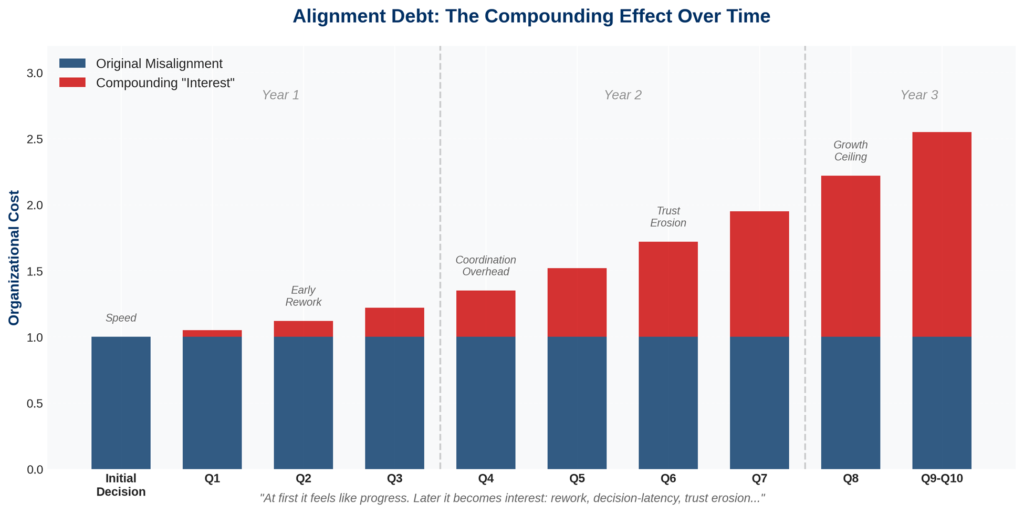
The Compounding Effect
* The actual timeline varies by organization, depending on scale, complexity, and rate of change.
Why Alignment Debt Is Dangerous
1. It Doesn’t Stay Contained—It Spreads Like a Network Effect
Misalignment behaves like a virus or a crack in a foundation. One team operating off-pattern gives adjacent teams permission to drift. One leader contradicting stated values normalizes contradiction. One successful shortcut becomes the template for future shortcuts.
Soon the organization begins to operate in a strange dual reality—saying one thing publicly and doing another operationally—until the contradiction stops being noticed. It becomes the culture.
The posters didn’t lie. They just weren’t the operating system.
2. The “Interest” Is Paid in Places Leaders Don’t Budget For
Alignment Debt rarely appears as a single crisis. It appears as a thousand small taxes that compound quietly:
Symptom | Root Cause |
Meetings that exist | Because trust doesn’t |
Reports that exist | Because clarity doesn’t |
Escalations that exist | Because decision rights don’t |
Rework that exists | Because “alignment later” finally arrived |
Coordination overhead | That becomes the largest hidden department |
Nothing looks catastrophic. Everything looks… normal. Busy. Active. Engaged.
And that is the trap: when misalignment becomes routine, people stop noticing the interest. They accept that “this is just how things work here.”
Misalignment is never free. Someone is always paying.
3. It Becomes the Invisible Ceiling on Growth
This is why Mission and Vision often fail to drive growth—not because they’re poorly written, but because they’re not operationally lived.
Growth demands:
- Clarity (so teams know where to aim)
- Alignment (so effort compounds instead of cancels)
- Consistency (so customers experience one coherent organization)
- Coherence (so decisions reinforce rather than contradict)
- Coordination (so handoffs don’t become friction points)
Without those, every strategic initiative becomes harder than it needs to be. Every new product becomes slower. Every customer promise becomes riskier. Every market expansion requires more internal coordination than external execution.
The organization stays active, but outcomes don’t scale with effort. You hire more people, yet velocity decreases. You run more initiatives, yet impact plateaus.
The organization didn’t slow down. It started paying interest.
The Seduction of Alignment Debt
And here’s the most uncomfortable part:
Alignment Debt is seductive.
In the short term, it masquerades as speed.
In the long term, it becomes the reason speed disappears.
Leaders choose it because it feels like pragmatism: “We can’t let perfect be the enemy of good.” “We need to keep moving.” “We’ll course-correct later.”
And they’re not entirely wrong. Sometimes speed does matter. Sometimes you must move before everything is perfectly aligned.
But the critical question isn’t whether you take on Alignment Debt. It’s whether you’re tracking what you’re borrowing—and whether you have any plan to pay it back.
Motion without progress is a financial statement—just not one your CFO can print.
The Question Worth Asking
So let me ask a question most organizations avoid because it doesn’t fit in a dashboard:
If you had to name your organization’s top five “interest payments” this quarter—where are you paying for misalignment every single week and calling it normal?
Because that answer will tell you more about your real operating system than any statement on the wall ever will.
Questions Worth Asking
- Where do we keep having the same conversation in different rooms?
- Where does work slow down after agreement is announced?
- What do we repeatedly “clarify” that should already be clear?
- Where are we paying coordination costs instead of creating customer value?
- Which behaviors get rewarded despite contradicting stated values?
- Where does “urgent” consistently trump “important”?
- What patterns do we tolerate because “that’s just how it works here”?
Your growth rate is not only a market outcome. It is also the interest rate on your Alignment Debt.