





When Founders Step Back
The Invisible Gap Between Energy, Authority, and Consequence
Over the past year, I have engaged in numerous conversations with founders of family-owned businesses across India. Different industries, different scales, different cities—yet the pattern has been remarkably consistent.
Most of these founders are in their mid-50s to early-60s. They built their businesses with grit, persistence, and an instinctive understanding of how markets actually work. They navigated capital constraints, regulatory uncertainty, and long stretches of personal sacrifice. The business was never an abstraction. It was deeply personal.
Today, many are preparing to step back.
Not because the business is failing. But because they are tired. And because the next generation is now ready—at least formally—to take over.
This transition, however, is rarely as smooth as it appears from the outside.
A Familiar but Uncomfortable Moment
In many family businesses, the handover happens quietly.
The founder reduces day-to-day involvement. The next generation—typically in their mid-20s to early-30s—steps into leadership roles. Titles change. Responsibilities shift. Decision rights are assumed to have moved.
And yet, something feels unsettled.
The founder senses it but often does not articulate it clearly. The next generation senses it too, but interprets it differently.
What is missing is not intelligence, education, or access to information.
It is something more subtle—and far more important.
Information Has Become Abundant. Consequence Has Not.
The next generation enters the business with advantages their parents never had:
- Immediate access to information
- Exposure to global ideas and frameworks
- Strong peer networks
- Comfort with tools, metrics, and technology
Their confidence is understandable—and, in many ways, justified.
But confidence is not the same as judgement.
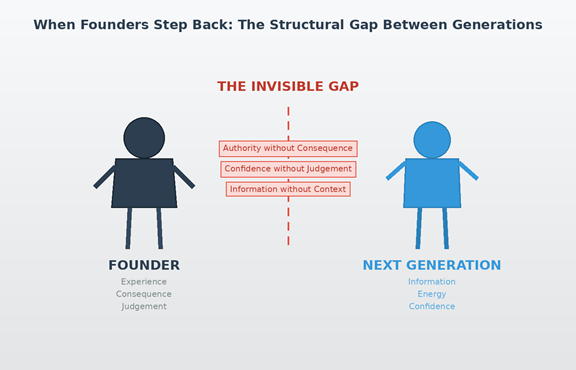
The founder’s generation learned through consequence:
- A pricing mistake could threaten payroll
- A poor customer decision could jeopardise survival
- A missed delivery could permanently damage trust
These experiences left scars—but they also built discernment.
In contrast, many successors inherit a business that already works. The operating environment is safer. The margin for error is wider. The cost of a poor decision is often absorbed by systems the founder put in place over decades.
This does not make the next generation incapable.
It simply means they have not yet earned consequence.
This Is Not a Passion Problem
It is tempting to describe this gap as a lack of hunger or drive.
That framing is misleading—and unfair.
What we are observing is not apathy. It is a different relationship with risk and urgency.
The founder built the business fighting for survival.
The successor is often optimising for correctness.
Neither approach is inherently wrong.
But as businesses grow in scale and complexity, optimisation without judgement becomes dangerous.
Why Founders Hesitate—And Then Step Away Anyway
Most founders deeply trust their children’s intent.
What they struggle with is knowing where the line lies:
- When to intervene
- When to let go
- When involvement becomes control
- When distance becomes abdication
Faced with this tension, many choose what feels emotionally safest.
They step back—and hope the next generation will figure it out.
Sometimes they do.
Often, the business absorbs the learning cost quietly.
Occasionally, the consequences surface much later—when course correction is far harder.
The Real Gap Is Not Generational—It Is Structural
This is where many discussions go astray.
The issue gets framed as:
- Old versus young
- Experience versus entitlement
- Wisdom versus energy
That framing creates defensiveness on all sides.
The real issue is simpler—and more uncomfortable:
The business has not been redesigned for a transition from energy-led leadership to consequence-led leadership.
Decision-making structures that worked when the founder was central no longer work when authority is distributed. At the same time, distributing authority without mechanisms for consequence creates blind spots.
What emerges is not a leadership vacuum—but a vacuum of decision discipline.
What Founders Often Discover
Through my conversations and observations across multiple family-owned businesses, I have noticed that founders often discover advice alone does not solve this transition.
Neither does tighter control.
Nor does complete withdrawal.
What begins to help is a different kind of conversation—one that shifts attention away from personalities and generations, and back to how decisions are actually being made, challenged, and owned as the business evolves.
Exactly what this looks like varies from business to business.
But it almost always involves re-examining how authority, judgement, and consequence are embedded into everyday decisions—not merely how roles are defined on paper.
A Closing Thought
For some founders, this realisation arrives late—often after the business has already begun to feel different. For others, it becomes a moment of clarity: the transition is not about letting go, but about redesigning how the business learns and decides without them at the centre.
These are not conversations that lend themselves to generic answers. They are specific to the business, the family, and the stage of growth.
Author’s Note
This article is based on direct conversations, professional observation, and patterns seen repeatedly across founder-led and family-owned businesses. These observations are also consistent with findings reported in multiple India-focused and global studies on family business succession, governance, and next-generation leadership. The intent is not to critique any individual or generation, but to reflect on a structural transition many businesses are navigating quietly today.
If this resonates with a transition you are navigating, it may be worth exploring together.
If you are a founder thinking through this transition, or a family business leader grappling with these questions, I would welcome a conversation. These discussions are most productive when they are specific, candid, and grounded in the actual dynamics of your business.
Let’s talk. Reach out at sridhar.iyer@kssconsulting.in