





Customer Centricity vs. Customer Relationship
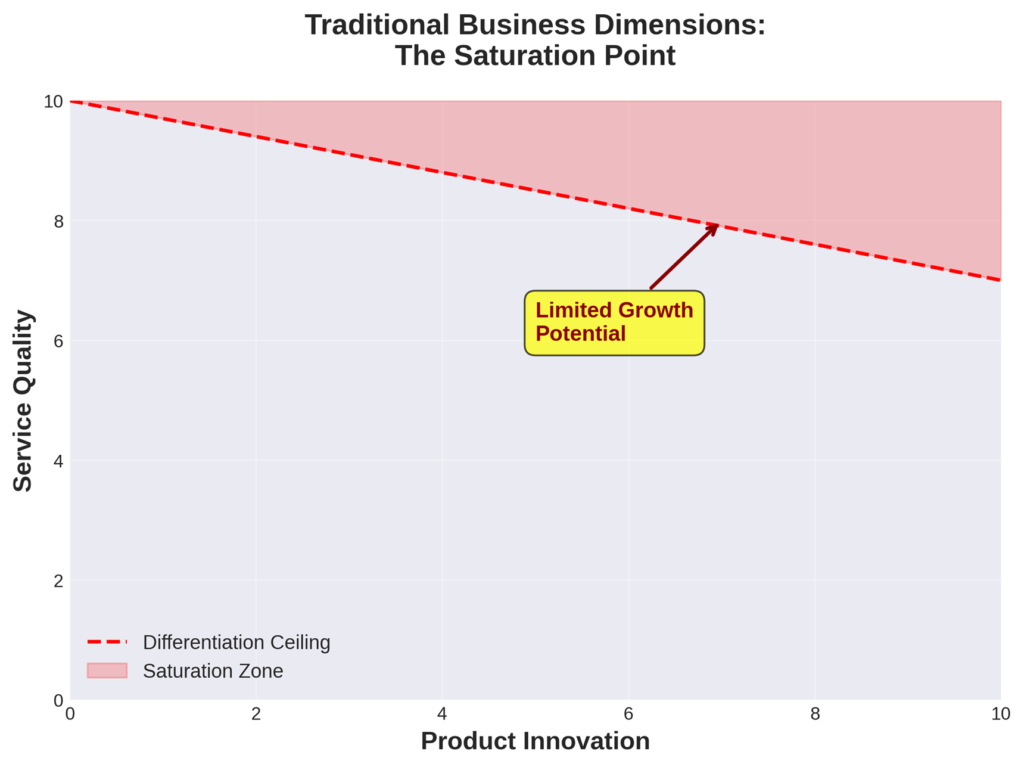
Figure 1: Traditional two-dimensional competitive space showing the saturation ceiling
The third dimension—Customer Centricity—was the natural evolution, the breakthrough that transformed the competitive landscape entirely.
Understanding the Critical Difference for Business Success
Two terms frequently used interchangeably in boardrooms and strategy meetings, often assumed to mean the same thing—or at least close enough. The truth, however, reveals something entirely different.
They are as different as chalk and cheese, leading to vastly different outcomes—intended or otherwise.
What is Customer Centricity?
Customer Centricity is not merely a business practice—it’s a strategic philosophy you commit to with unwavering focus. Its objective is subtle yet profound, and its genesis was born from necessity.
The Evolution Beyond Product and Service
Customer Centricity emerged when products and services reached their zenith—when saturation set in and differentiation became a blur. Imagine you have a great product or an excellent service. There’s only so far you can push along either of these axes. Eventually, you hit a ceiling.
The Common Misconception
Ask any random organization—regardless of size—about their customer focus, and the typical response is: “Yes, absolutely! As an organization, we are extremely focused on the customer. We know what products and services they require, we understand how they perceive us, and we have great brand equity.”
This sounds impressive. But it still isn’t Customer Centricity.
The True Nature of Customer Centricity
Customer Centricity is more subtle than simply knowing your customers. When correctly aligned and targeted, it becomes a sharp arrow in your arsenal—one that doesn’t miss its target and delivers exponential results.
The primary return on investment from Customer Centricity comes from:
- Dramatically reduced Customer Acquisition Costs (CAC)
- Enhanced Customer Lifetime Value (LTV)
- Focused reduction in customer churn
- Excellence in dispute resolution
This isn’t something you merely post on office walls. True Customer Centricity extends throughout the entire organization—from R&D to Sales, Marketing to Customer Support. It requires a top-down, culture-driven approach to be genuinely effective
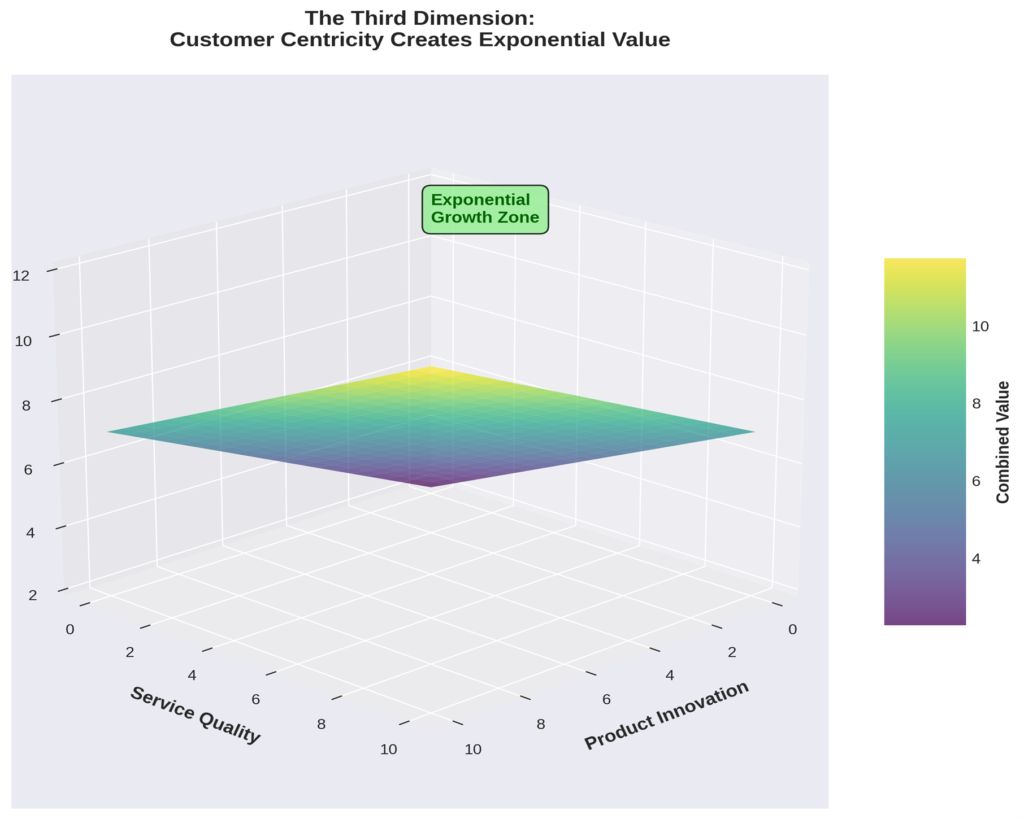
Figure : The three-dimensional competitive space—Customer Centricity opens exponential growth potential
Customer Relationship: The Double-Edged Sword
If Customer Centricity is your master arrow, then Customer Relationship is a double-edged sword—powerful but dangerous. One must handle it with utmost care, as a reverse sweep can make you bleed.
The Delight Trap
Customer Relationship anchors itself in customer delight. “A delighted customer is a repeat customer”—this mantra echoes across conference rooms worldwide. But customer relationships are an expensive affair, and the ROI can be extraordinarily elusive to measure and justify.
I’ve witnessed large corporations throw substantial resources at customer delight: goodies, treats, freebies, discounts, expensive outings, dinners, and cocktails. It’s a salesman’s delight as much as the customer’s!
The Economic Reality
At the end of the cycle, when you finally close a deal, the calculation becomes sobering: Deal Value minus Cost of Deal more often than not delivers grief rather than profit.
The customer? Absolutely delighted. Not only did they receive all the perks, but they also secured a heavily discounted deal. The sales team celebrates. The organization congratulates itself. Yet the numbers tell a different story.
This is why Customer Relationship must be wielded judiciously—the reference to a double-edged sword is not metaphorical. Even seasoned sales professionals invariably fall into this trap.
A Different Approach: Value Over Relationships
It’s a philosophy that companies must carefully adapt, striking a delicate balance. Throughout my career, I’ve personally closed multi-million dollar deals with large organizations in challenging, slow-growth markets.
Operating at the other end of the spectrum—selling through value propositions—sometimes made me unpopular. I didn’t engage in the fancy tactics alluded to above. Yet my champions within customer organizations? They were the procurement and supply chain management professionals in large enterprises.
Why? Because value speaks louder than entertainment. When you demonstrate genuine ROI, reduce their total cost of ownership, and solve their actual business problems, you build relationships founded on substance rather than superficial delight.
The Wisdom of Balance
With years of wisdom behind me, when I reflect and share these insights, my advice is this:
You require a combination of both Customer Centricity and Customer Relationship. Neither alone will suffice. But remember—the relationship component is that double-edged sword. Handle it carefully, strategically, and always with clear-eyed awareness of its true costs.
Customer Centricity provides the strategic foundation—the culture, the systems, the measurable outcomes. Customer Relationship provides the human touch—the moments that matter, applied judiciously where they truly create value.
Master both, understand their distinctions, and you’ll unlock exponential growth in that third dimension—the one your competitors may not even know exists.